A well water test kit from the hardware store can tell you something is worth checking. It cannot tell you your well is fine. For that you need a state-certified lab at least once a year for total coliform bacteria, nitrate, total dissolved solids and pH, which is what EPA advises, plus a wider panel chosen for where you live.
This page is part of our well water guide. It covers which tests you need and how often, what independent studies found about kits, what labs charge, and how to take a sample the lab will accept. WaterPlain has no lab and has not tested any kit. We report published evaluations, agency guidance and sellers’ own listings, and we earn nothing from any test you buy.
The short answer
- Every year: bacteria (total coliform and E. coli) and nitrate at a certified lab. EPA and CDC add pH and total dissolved solids (TDS).
- Once now, then every 3 to 5 years: a metals panel covering at least arsenic, lead, manganese and iron. Agencies differ on the interval, so this is our default.
- Only if your location calls for it: solvents and fuel compounds (VOCs), pesticides, radon, PFAS, and gas-drilling markers.
- A kit is fine for: hardness, a TDS reading, and a quick look between lab tests.
- A kit is not enough for: a baby or pregnancy in the home, repeat stomach illness, a flood or well repair, a fuel smell, a home sale, or any decision about lead, arsenic or nitrate.
- Example costs: $70 a year for bacteria and nitrate at Wisconsin’s state lab, free in nearly all Iowa counties, and about $200 to $400 for a broad mail-in lab kit.
Testing matters more on a well because nobody does it for you. EPA says private wells are not regulated under the Safe Drinking Water Act, and owners are responsible for their own water. In a USGS study of 2,100 domestic wells, about one in five had at least one contaminant above a human-health benchmark, most often metals, radionuclides or nitrate. USGS and CDC researchers later estimated that about 2.1 million people in the lower 48 states use domestic wells with predicted arsenic above 10 µg/L.
Kit or lab: which you need
| Your situation | Use | Why |
|---|---|---|
| Routine yearly check | Certified lab: bacteria and nitrate at minimum | CDC recommends a state-certified lab for yearly testing |
| Baby in the home, pregnant, or planning to be | Certified lab: nitrate and lead first | Wisconsin DHS says to test both before the water is used by babies or anyone who is or may become pregnant |
| Repeat stomach illness in the household | Certified lab for coliform bacteria, and call your doctor and health department | EPA lists this as a reason to test. A strip gives no reassurance here |
| Flood, well repair or new pump | Certified lab for bacteria, after any disinfection | CDC and EPA both name these events |
| Fuel or chemical smell | No kit. Use bottled water and call the health department | CDC: boiling or disinfection will not make this water safe |
| Buying or selling a home | Certified lab, using the lab’s own bottles | Some states require it, and lenders may ask. See home sales |
| Choosing a softener or filter | Lab report for iron, manganese, hardness and pH | Treatment follows the numbers, and Penn State says to be cautious of results from uncertified labs or water treatment salespeople |
| Hardness only | Home kit is fine | Our hardness test kit guide covers the options. Feed the result into the softener sizing tool |
| Watching TDS between lab tests | Home meter is fine | A TDS meter shows drift, not what the dissolved material is |
| Curiosity, or a check between lab tests | Strip kit, as a screen | Follow up anything odd at a lab, and do not read a clean strip as an all-clear |
What studies found about home kits
We found no federal program that certifies consumer water test kits. EPA itself says it cannot test home water and sends well owners to their state program or a certified lab. Emily Kumpel, senior author of the UMass Amherst study below, calls it “an unregulated space”. Four independent evaluations are worth knowing:
| Evaluation | What was tested | What it found |
|---|---|---|
| UMass Amherst, 2025 (paper) | 8 kits for iron, copper, manganese and fluoride, in deionized, tap and river water | No multi-parameter kit detected low iron. Three of four single-parameter kits did, though often too high or too low. At high iron, most multi-parameter kits read low. Many kits did well in deionized water and poorly in real water |
| Virginia Tech and others, 2021 | 16 lead kit brands | 12 brands were unsuitable for drinking water, with detection limits of 5 to 20 mg/L. That is hundreds to more than a thousand times the 15 µg/L action level. Binary strips caught dissolved lead at relevant levels but missed particles |
| Washington State study, 2008 | One nitrate strip, used by residents in 102 homes, against a lab | Moderate match (r = 0.72). Where nitrate was present, the lab read higher than the strip in 81% of homes. 7% of people struggled to tell the colors apart |
| San Francisco utility, 2018 to 2019 | 3 kit brands, over 400 tests on city tap water | Above 80% agreement with the lab on coliform, nitrate, nitrite and iron for all three. Mixed on lead and copper, with data quality problems in one brand. Below 60% on pH for two brands. Below 60% on hardness, which the utility blames on its very soft water; above 80% in harder water |
Four things follow for a well owner.
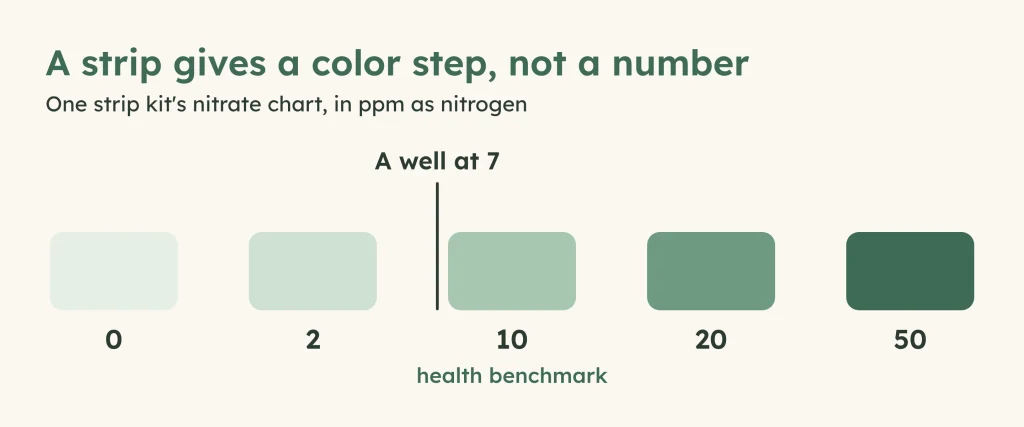
- A strip gives a color step, not a number. One strip kit listed at $7.49 for two tests prints its nitrate chart at 0, 2, 10, 20 and 50 ppm as nitrogen. A well at 7 sits between two blocks, and the next step up is the health benchmark. That is the range where you most need a number.
- The errors in these studies often run the unsafe way. Strips that read low on nitrate and kits that read low on high iron both make water look better than it is.
- Lead on a well is often in particles. In a Virginia study of 2,146 homeowner samples, almost 20% of first-draw samples were above 15 µg/L, and on average 47% of the lead in a tested subset was particulate. That is the form the strips missed. The samples came from homeowners who chose to test, so this is not a state average.
- City-water results do not transfer. San Francisco’s kits were tested on treated tap water. A kit that agrees with a lab there tells you little about how it behaves in a well with iron, sulfur or high minerals. UMass found real water was where kits struggled.
Kumpel says kits “might be a good first cut”, and that is the right way to use them. None of the evaluations above covered arsenic, uranium, radon, VOCs or PFAS, so we know of no independent basis for trusting a home kit on those. Send them to a lab. If a home kit shows bacteria, switch to bottled water or another safe source until a lab has checked it.
The four ways to test
| Option | Price seen | Good for | Limits |
|---|---|---|---|
| Strip or dip kit | $7.49 for two tests | Hardness, a quick look | Color steps, no certification, and the accuracy problems above |
| Single-parameter home kit | Varies by test; no reliable range found | One known concern, such as iron | Still unregulated. Bacteria kits usually need about 48 hours of waiting, per SFPUC guidance |
| Mail-in lab kit | $209 to $399 at Tap Score; $220 to $255 at WaterCheck, return shipping extra | A broad one-time panel, and homes far from a lab | Bacteria timing in the mail, and state certification may not apply. See choosing a lab |
| Local certified lab or health department | $21 to $55 in Washington for nitrate and coliform tests; $75 for Oklahoma’s annual well list of bacteria, nitrate and nitrite, pH and conductivity; free in nearly all Iowa counties for bacteria, nitrate, arsenic and manganese, for qualifying private wells | Yearly tests and anything that matters | You collect on the lab’s schedule and may need to drop off in person |
Mail-in prices are seller list prices seen on 2 November 2026. Look for a university or county program too. Virginia’s household water clinics cost $70 a kit for a panel including bacteria, lead, arsenic and nitrate. The program’s own slides call the lab a research lab, not state-certified, with results for information and education, so it may not suit a sale. Wisconsin’s WellTAP may cover testing for some households with a pregnant person, a young child or someone with a weakened immune system.
What to test for
Start with the core four from EPA and CDC: total coliform bacteria, nitrate, TDS and pH. Ask for E. coli with the coliform test. Penn State pairs them, because E. coli points to animal waste or human sewage.
Then add arsenic and lead at least once. A clean core-four result says nothing about metals. Add the rest from what is around your well. This list follows EPA’s chart:
| What you see or live near | Test for |
|---|---|
| Lead or copper plumbing, corroding pipes | pH, lead, copper, corrosion |
| Intensive farming | Nitrate, nitrite, pesticides, coliform |
| Mining | Metals, pH, corrosion |
| Gas drilling | Chloride, sodium, barium, strontium |
| Dump, factory, gas station or dry cleaner | VOCs, TDS, pH, sulfate, chloride, metals |
| Fuel smell or buried fuel tanks | VOCs |
| Salty taste or a salted road nearby | Chloride, TDS, sodium |
| Rust or black stains on fixtures or laundry | Iron, copper, manganese |
| Scale, or soap that will not lather | Hardness |
| Bad taste or smell | Hydrogen sulfide, corrosion, metals. Rotten egg smell has its own guide |
| Radon in your area or indoor air | Radon |
Your county matters too. CDC says to ask your health or environmental department which local contaminants to add. Wisconsin, for example, names strontium for eastern and northern parts of the state and yearly arsenic in three counties. For radon, the state lab there notes that water tests are generally not necessary unless air radon levels are high. On PFAS, Wisconsin says testing is mainly for homes near a known contamination site. Our PFAS testing guide covers that decision. It costs far more: New Jersey estimates $600 to $900 per sample for the PFAS group that includes PFOA, PFOS and PFNA.
How often to test
Agencies agree on yearly bacteria testing and differ on the rest.
| Source | Bacteria | Nitrate | pH, TDS | Metals |
|---|---|---|---|---|
| EPA | Yearly | Yearly | Yearly | Based on local risk |
| CDC | Yearly | Yearly | Yearly | Ask your health department |
| Minnesota | Yearly | Yearly in its nitrate guidance; its testing page says every other year | Not listed | Arsenic, lead and manganese at least once |
| Penn State | Yearly | Every 3 years if near septic or farms | Every 3 years | By land use, every 3 years |
| Iowa DNR | Yearly | Yearly | Not listed | Arsenic and manganese every 3 years |
| Wisconsin DHS | Yearly | Yearly | Not listed | Arsenic and lead every 5 years |
A sensible default: bacteria and nitrate every year, a metals panel now and every 3 to 5 years, and pH and TDS whenever the lab offers them cheaply. If a past test found something, follow your health department, which may ask for more.
Test right away if
EPA and CDC name these triggers:
- Flooding, construction or land disturbance near the well
- Well repair, or replacement of any part of the system
- A change in taste, color or smell
- Known water problems in your area
- Someone becomes pregnant or a child comes to live with you
What testing costs: a worked example
These prices come from the Wisconsin State Laboratory of Hygiene list effective 1 July 2026. Other states and private labs will differ, so get a local quote.
| Plan | Tests added | Running total | Usual lab time |
|---|---|---|---|
| Yearly minimum | Bacteria $35, nitrate $35 | $70 | 2 to 3 business days |
| First wider check | Metals screen $97 | $167 | 10 business days |
| Near fuel, a dump or a dry cleaner | VOC screen $141 | $308 | 21 business days |
| High indoor radon | Radon in water $111 | $419 | 5 business days for radon |
The lab’s $450 Homeowner Package is the first three rows plus fluoride, atrazine and nitrite. By our arithmetic that is the exact sum of the separate prices, so there is no bundle saving. Buy only what your location calls for.
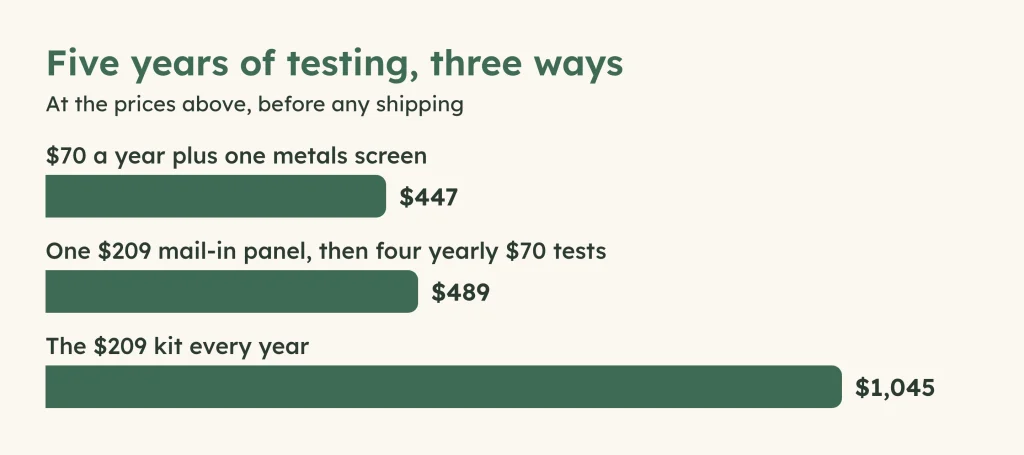
Over five years at those prices, $70 a year plus one metals screen comes to $447. One $209 mail-in panel followed by four yearly $70 tests comes to $489, before any shipping. Buying that $209 kit every year would cost $1,045. The useful pattern is one broad panel, then cheap yearly bacteria and nitrate tests.
How to choose a lab
- Start with your state’s list. EPA keeps links to each state certification program. Your county health department will often know the closest lab, and some offer free well testing.
- Ask whether the lab is certified in your state for those tests in drinking water. Certification is by state and by test. WaterCheck’s lab says it is certified in 38 states and territories and invites you to check yours. It calls one of its well kits an “informational” analysis.
- Do not confuse ISO with state certification. Tap Score says its labs hold ISO/IEC 17025 and adds that this “does not mean every test is separately certified or approved by a regulatory agency”. An informational result can be useful, but it may not satisfy a state or a lender.
- Read “EPA” claims carefully. EPA-approved methods exist for labs. That does not make a kit EPA-approved, and in the federal setup it is states that certify labs.
- Ask about bacteria timing. See the sample steps below. Tap Score’s $399 kit includes overnight shipping and a cooler, and the seller aims it at wells with suspected bacteria. Its $209 kit lists coliform with standard two-day shipping to the lab, and offers overnight as a checkout choice, so ask which one keeps your sample within the lab’s limit. WaterCheck’s kits require next-day return shipping at your cost.
- Ask for the reporting limit. It should sit below the benchmark you care about. A result of “less than” a number above the benchmark tells you nothing.
- Check who gains from the result. Prefer a lab that does not sell treatment. If a dealer offers a free test, ask whether it covers coliform and nitrate and who ran it.
How to take a good sample
Bad sampling ruins good lab work. Your lab’s sheet overrides everything here, because methods differ. Virginia’s program says leave the aerator on, while Penn State says many labs recommend removing it for bacteria.
- Plan the day. Call first. Penn State says most labs will not accept samples on Fridays or before holidays, and UW-Stevens Point takes no bacteria samples on Fridays. EPA Region 8 tells public systems to sample early in the week.
- Know your clock. Penn State says to deliver bacteria samples within 24 hours. Oregon gives the same window for home sales. Public water systems work to 30 hours, and EPA Region 8 warns the sample must arrive before that, so the lab has time to start.
- Use the lab’s bottles. Some contain a chemical that removes chlorine, so do not rinse them unless told to. Never reuse a food or drink container.
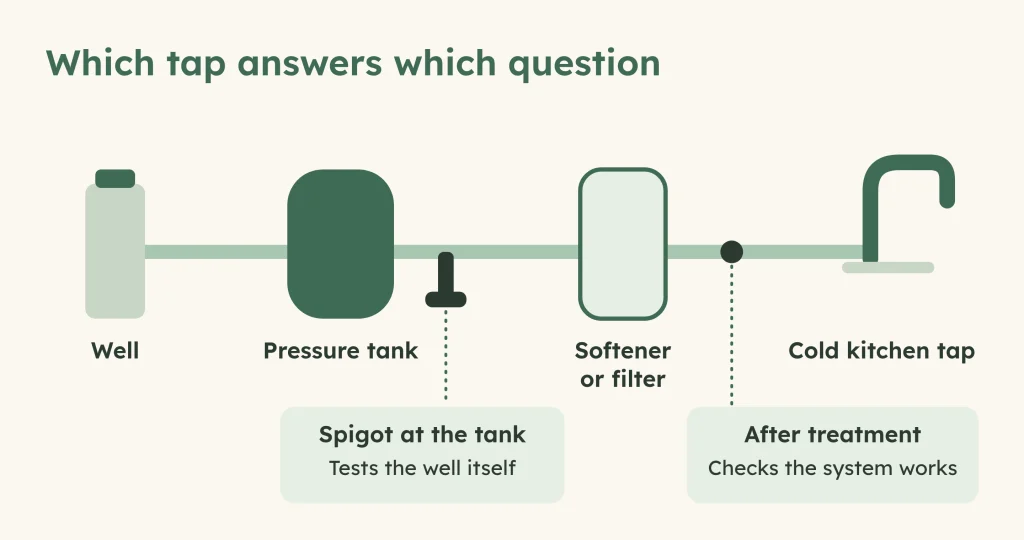
- Pick the right tap. Drinking water usually comes from the cold kitchen tap. To test the well itself, Penn State says to use the spigot at the pressure tank, before any softener or filter. Test after treatment too if you want to know the system works.
- Take lead and copper first. These need water that has stood in the pipes: 6 to 8 hours in Virginia’s instructions, at least 12 in Penn State’s. Collect before anyone uses water in the morning.
- Then flush and take the rest. Virginia runs the tap at least a minute. Penn State says a few minutes. Do not touch the inside of the cap or bottle.
- Keep it cold and move fast. Refrigerate or use ice, and get it to the lab the same day if you can.
Wait after chlorinating. If you have shock chlorinated the well, give the chlorine time to clear before a bacteria test. Timing advice varies: CDC says at least 7 to 10 days, Minnesota 2 to 4 weeks, and Penn State 10 to 14 days. Ask your lab or health department.
How to read your results
Penn State’s guide explains the report. Most results are in mg/L, which is the same as ppm. Bacteria appear per 100 mL, often as MPN, “most probable number”. Labs do not report zero. “<0.003” means nothing was found above the lab’s limit. “>201” means more bacteria than the lab could count.
Watch the nitrate unit. EPA’s benchmark is 10 mg/L as nitrogen. By molecular weight that is about 44 mg/L as nitrate (our calculation). A report showing “30 mg/L” could be either, so check the label.
The figures below are written for public water systems, not for private wells. Use them as benchmarks. Being under one does not prove water is safe. Several have a health goal of zero.
| Test | Benchmark | Note |
|---|---|---|
| Total coliform, E. coli | None detected | Health-based standard is zero. Treat any positive as a problem |
| Nitrate | 10 mg/L as N | Nitrite is 1 mg/L as N. 40 CFR 141.62 |
| Arsenic | 0.010 mg/L (10 µg/L) | Health goal is zero. 40 CFR 141.62 |
| Lead | Action level 0.015 mg/L today; 0.010 mg/L applies from 1 November 2027 | An action level is not a safe level. EPA sets the goal at zero |
| Copper | Action level 1.3 mg/L | Health goal is also 1.3 mg/L |
| Fluoride | 4.0 mg/L; 2.0 mg/L secondary | 40 CFR 141.62 and 143.3 |
| Uranium | 30 µg/L | 40 CFR 141.66. Health goal is zero |
| Manganese | 0.05 mg/L secondary | Minnesota’s health guidance is 100 µg/L or less for infants who drink tap water or formula made with it, and 300 µg/L or less for others |
| Iron | 0.3 mg/L secondary | Staining and taste. Not federally enforced |
| pH | 6.5 to 8.5 secondary | Low pH can point to corrosion |
| TDS | 500 mg/L secondary | Penn State also watches for change between tests |
| Chloride, sulfate | 250 mg/L each, secondary | Chloride can point to road salt or drilling |
| Hardness | No federal limit | Connecticut DPH: no recognized standard |
| PFOA, PFOS | 4.0 ppt each | 40 CFR 141.61. Systems must comply by 26 April 2029. Proposed changes were not final as of 2 November 2026 |
If a result comes back high
Take results to your county or state health department first, not to a product. CDC says the same: switch to a safe source, then ask them to help interpret results and plan next steps.
Coliform or E. coli
Minnesota’s advice for coliform: use boiled or bottled water for drinking and cooking. If nitrate or arsenic was also found, do not rely on boiling, because it can concentrate them. Disinfect the well or hire a licensed contractor, then retest. If bacteria return, work with a contractor, since the cause may be debris, a cracked casing or surface water getting in. Boiling is a stopgap, not a fix. Penn State treats E. coli as more serious than coliform alone, because it means human or animal waste is entering the water.
Nitrate above 10 mg/L as N
Minnesota’s advice: switch to a safe source such as bottled water. Do not give the water to babies under six months. Bottle-fed babies that age are at the highest risk of blue baby syndrome. Even with home treatment, Minnesota says these babies should not drink it, in case treatment fails. Do not boil it: boiling raises the nitrate level. Have a licensed contractor inspect the well and look for sources on your property.
Lead
CDC says boiling will not reduce lead, and that no safe blood lead level has been identified for young children. Compare first-draw and flushed samples. In the Virginia study, a 5-minute flush brought most systems under 15 µg/L, but some went up, perhaps from particles or lead-bearing parts upstream of the faucet. Do not assume flushing works in your house.
Fuel or chemical smell
Stop using the water and call your health department. CDC is plain on this: boiling and disinfection will not make it safe.
Once you know what is in the water, our well water filtration guide covers treatment order. A softener is not a safety device, and no filter should go on before you know what it needs to remove.
Buying or selling a home
Rules vary by state. Two examples:
- Oregon: the seller must test for arsenic, nitrate and total coliform at an accredited lab, and send results to the buyer and the state within 90 days.
- New Jersey: the Private Well Testing Act requires testing before closing, at a state-certified lab. It does not stop a sale if the water is over a standard, so buyer and seller negotiate what happens next.
Elsewhere, write a test into the offer. Have the lab or an independent person collect the sample, and ask your lender what it needs. Wisconsin’s state lab sells a $146 HUD/FHA-VA loan package covering coliform, E. coli, lead, nitrate and nitrite, which shows the sort of panel lenders can ask for. Add arsenic and anything local. A loan panel is a minimum, not a full picture.
This page is general information, not medical or professional advice. For test results or illness, contact your state or county health department or a certified lab. Lab prices and seller listings change, so check them before you order.
Facts checked against primary sources on 2 November 2026.
Sources
- EPA: protect your home's water, private wells
- EPA: private drinking water wells
- USGS: what's in your well water?
- USGS news release: about 2.1 million people using wells high in arsenic (Ayotte and others, 2017)
- CDC: guidelines for testing well water
- Wisconsin DHS: drinking water from private wells
- CDC: how to disinfect wells after an emergency
- Penn State Extension: testing your drinking water
- EPA: certification programs and certified labs for drinking water
- UMass Amherst news release: evaluation of home water test kits, via EurekAlert
- D'Andrea and Kumpel, Journal of Water and Health, 2025
- Kriss and others, Environmental Science & Technology, 2021: at-home lead test kits (PubMed abstract)
- Searles Nielsen and others, 2008: nitrate test strips in drinking water (PubMed abstract)
- San Francisco Public Utilities Commission: home test kits
- Seller listing: 2-test strip kit, color chart steps and price
- Pieper and others, Journal of Water and Health, 2015: lead in private systems in Virginia
- Seller listing: Tap Score Essential Well Water Test
- Seller listing: Tap Score Advanced Well Water Test
- Seller listing: WaterCheck Basic Well Water Test
- Seller listing: WaterCheck Standard Well Water Test
- Washington DOH 331-798: nitrate and coliform testing labs, 27 March 2026
- Oklahoma DEQ: lab services fee schedule FY27
- Iowa DNR: private well testing
- Loudoun County: household water quality testing program
- Virginia Household Water Quality Program: 2026 presentation
- Wisconsin State Laboratory of Hygiene: public prices, effective 1 July 2026
- NJDEP: PFAS in drinking water FAQ, revised May 2026
- Minnesota Department of Health: well water testing
- Minnesota Department of Health: nitrate in well water
- National Testing Laboratories: WaterCheck home page
- Tap Score: certified labs and testing
- Virginia Household Water Quality Program: sample collection instructions, 12 August 2025
- UW-Stevens Point: private well water testing
- EPA Region 8: Wyoming drinking water newsletter, May 2025
- Oregon Health Authority: domestic well testing regulations
- Minnesota Department of Health: well disinfection
- Penn State Extension: shock chlorination of wells and springs
- Penn State Extension: interpreting your water test report
- eCFR: 40 CFR 141.62, inorganic contaminant limits
- eCFR: 40 CFR 141.80, lead and copper
- EPA: National Primary Drinking Water Regulations
- eCFR: 40 CFR 143.3, secondary levels
- eCFR: 40 CFR 141.66, radionuclide limits
- Minnesota Department of Health: manganese in drinking water
- EPA: secondary drinking water standards
- Connecticut DPH: hard water and softeners, Pub. 29, November 2023
- eCFR: 40 CFR 141.61, organic contaminant limits including PFAS
- EPA: proposed PFOA and PFOS compliance extension rule
- Minnesota Department of Health: bacteria in well water
- CDC: lead in drinking water
- NJDEP: Private Well Testing Act