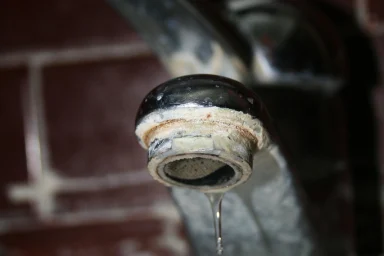
Hard water is water with a lot of dissolved calcium and magnesium, and it is a nuisance, not a danger. EPA says it is not a health concern, though it builds up on plumbing and makes soap harder to lather. So the useful question isn’t “is my water hard?” but “how hard is it, and is that causing a problem worth paying to fix?” This page answers that in five steps and points you to the right guide at each one. If you already have a reliable number, skip to step 3.
This is general information, not medical or professional advice. WaterPlain has no lab: everything here comes from published sources.
Step 1: Know what the number counts
Water picks up hardness on its way through soil and rock, especially limestone, chalk and gypsum. It’s a natural property, not contamination. EPA says it is most common in the Southwest and Midwest and in other areas that rely mainly on groundwater. In a USGS study of about 2,100 domestic wells, about 60% were hard by the 120 mg/L line. That’s a sample of private wells, not a count of homes, and no map can give you your own figure.
The number itself is a sum. Calcium and magnesium are added together and written as if all of it were calcium carbonate, using the Standard Methods formula. That’s why a calcium line on a lab report isn’t your hardness. Take a well with calcium at 60 mg/L and magnesium at 20 mg/L. Its total hardness is 232.2 mg/L as calcium carbonate, or 13.6 grains per gallon (gpg), which is very hard. Read the calcium line alone and you would think it was 3.5 gpg.
Heat is what turns hardness into a visible problem. Calcite gets less soluble as water warms, so hot water leaves its minerals on the hottest surfaces, such as heater elements. Boiling isn’t a softening method, though, because part of the hardness stays behind. Our explainer on what hard water is and where it comes from covers the chemistry, and why the popular “85% of US homes” figure doesn’t trace back to USGS.
Step 2: Get your number
Scale and poor lather are hints. Softener decisions turn on a number, so get one before you shop.
| Method | What you get | Best for |
|---|---|---|
| Utility report or phone call | A system figure or range | City water, as a free first step |
| Lab test | A reported result, usually with other tests | Wells, or any time you want iron and safety tests too |
| Drop test kit | A count you can turn into a number | Sizing a softener or checking a dealer’s figure |
| Test strips | A band from a color chart | A rough answer, or checking a softener still works |
| TDS meter | Total dissolved solids | Not hardness |
On city water, start with your annual water quality report, which suppliers must send each year by July 1. Hardness isn’t a regulated contaminant, so the report may leave it out. If it does, call the utility and ask for the figure and range for your service area.
For a home test, know the limits. Hach, which sells both strips and kits, says to use its strips “when a general range for hardness is sufficient”, and on its wide-range chart the next color after 7 gpg is 14.6 gpg. Our guide to water hardness test kits compares each option, with prices and steps. Test ahead of any softener, or you are only measuring the softener.
On a well, no utility has measured your water, and a hardness test says nothing about bacteria or nitrate. Our well water testing guide covers what to order, and iron is worth adding because it affects softener choice and sizing. A TDS meter won’t help here: softening swaps minerals rather than removing them, so softened water can read much like the hard water it came from.
Step 3: Read your number
Hardness is reported in gpg or in mg/L as calcium carbonate, which is about the same as parts per million (ppm). Connecticut’s health department gives one gpg as 17.1 ppm. Two labels are in common use, from USGS and from extension services such as Penn State.
| gpg | mg/L as calcium carbonate | USGS | Extension |
|---|---|---|---|
| Under 1 | Under 17 | Soft | Soft |
| 1 to 3.5 | 17 to 60 | Soft | Slightly hard |
| 3.5 to 7 | 61 to 120 | Moderately hard | Moderately hard |
| 7 to 10.5 | 121 to 180 | Hard | Hard |
| Over 10.5 | Over 180 | Very hard | Very hard |
These lines are conventions, not safety limits. Connecticut says there is no recognized standard or maximum contaminant level for it, and hardness has no entry in EPA’s secondary drinking water standards. Our water hardness converter switches between gpg, ppm and European degrees, and works out total hardness from separate calcium and magnesium results.
Step 4: Weigh what it does in your home
The number matters less than the problems you actually have. Hard water’s real costs are soap scum, spotted glasses, clogged showerheads and scale in heaters. Softened water brings added sodium, salt to buy, water used to regenerate and a machine to maintain. Our comparison of hard water and soft water sets those side by side, and separates soft, softened and demineralized water.
Two selling points deserve a closer look:
- Energy savings. Most of the claims we read trace back to one Battelle lab study prepared for the Water Quality Association, run on about 26 gpg water under accelerated conditions. Gas tank efficiency fell from 70.4% to 67.4%, electric tank efficiency didn’t change, and a tankless gas heater fell from 80% to 72%. Battelle’s estimate at 15 gpg over 15 years works out to about $20 a year extra for a gas tank and $53 for tankless, including deliming, leaving out what a softener costs. Our reading: on a tank heater, energy alone is a weak reason to buy. Tankless owners have a stronger case.
- Skin. In a randomized trial of 336 children with eczema in hard-water areas of England, nurses who didn’t know which homes had softeners found no added benefit over usual care after 12 weeks. See a doctor about eczema rather than expecting a change of water to treat it.
One limit applies to everything on this page: a hardness result is a single number. It tells you nothing about lead, nitrate or bacteria. If someone is sick, or a result worries you, go to your state or county health department or a certified lab, not to a product.
Step 5: Choose a fix, or none
No federal rule says when to soften, and the sources set the line in different places.
| Your hardness | What the sources say |
|---|---|
| Under 7 gpg | Virginia Tech: generally no treatment needed |
| 7 to 10.5 gpg | Virginia Tech: treat only if it is causing a problem. Minnesota: you might need a softener above 7 gpg |
| Over 10.5 gpg | EPA says to install one only with substantial hardness, such as above 180 mg/L or 10 gpg, or where a local water authority or code recommends one. Those two figures don’t quite match, since 180 mg/L is 10.5 gpg |
Living with it
In the middle range, try the cheap fixes first. Connecticut suggests detergents with polyphosphates instead of soap alone, and cleaning scale from heater elements and flushing, following your heater’s manual. USGS suggests running vinegar through coffee makers. If the trouble is mainly in the bathroom, read our guide to hard water shower filters before you buy one. Most reduce chlorine and leave calcium and magnesium in place. One real shower softener gives about three 12-minute showers at 15 gpg, by the maker’s chart, before you recharge it with salt.
Deciding on a softener
If the hardness is causing you real trouble, our guide to whether you need a water softener takes the decision further, including iron, sodium diets and septic systems. Our water softeners section covers the options. Before you shop, know three things:
- Softeners don’t purify. They don’t remove bacteria, lead, nitrate or pesticides. See how softeners differ from filters.
- Salt-free isn’t the same thing. Salt-free conditioners work differently, so check what they do and don’t do.
- Sodium goes up. A salt-based softener adds about 8 mg/L of sodium per gpg removed. At 15 gpg, 2 liters a day adds about 240 mg, or about 10% of the 2,300 mg daily limit. With high blood pressure, Minnesota says to ask a doctor. An unsoftened cold kitchen tap is the simplest fix.
Check local rules too, since discharge rules vary. If a softener still makes sense, take your drop-test or lab number to our softener size calculator, then price it with our softener cost calculator. Penn State puts hardware alone at around $500 to $1,500, on a page updated in September 2025, and local quotes vary.
Facts checked against primary sources on 2 November 2026. Figures come from the guides linked above, where each is cited.