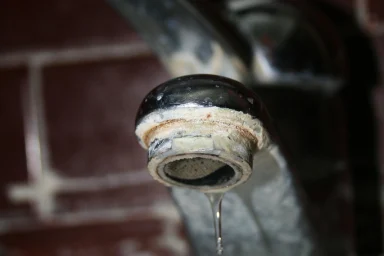
Nobody checks a private well for you. EPA says private wells are not regulated under the Safe Drinking Water Act and that owners are responsible for their own water. The work goes in a set order: test at a certified lab, deal with any health result, fix what is wrong at the well, and only then buy treatment for what is left. Starting with a filter gets that backwards, because no filter should go on before you know what it needs to remove.
This page walks that order, with the right guide at each step. If you have a safety worry, start with the table.
This is general information, not medical or professional advice. Take well test results and any illness to your state or county health department or a certified lab.
Safety first: what to do now
| What you notice | Do this first | Then read |
|---|---|---|
| Fuel or chemical smell in the water | Stop using it, drink bottled water and call your health department. CDC says boiling or disinfection will not make it safe | Step 1 |
| Rotten-egg smell in the house with no water running | Treat it as a possible gas leak. If it is strong or you are unsure, leave first, then call the gas company or 911 from away from the smell | Step 3, if it proves to be the water |
| A flood reached the well | EPA says do not turn on the pump, because of the danger of electric shock. Check with local authorities first | Step 2 |
| Coliform or E. coli on a test | Switch to safe water now and call your county or state health department | Step 2 |
| Nitrate above 10 mg/L as nitrogen | Switch to a safe source and keep the water away from babies under six months. Do not boil it, because boiling raises the level | Step 4 |
Step 1: Test at a certified lab
In a USGS study of 2,100 domestic wells, about one in five had at least one contaminant above a human-health benchmark, most often metals, radionuclides or nitrate.
CDC says to test at least once a year for total coliform, nitrates, total dissolved solids and pH. Agencies differ on the rest, so here is the default we suggest:
- Every year: total coliform with E. coli, and nitrate, at a certified lab. Add pH and total dissolved solids.
- Now, then every 3 to 5 years: a metals panel covering at least arsenic, lead, manganese and iron.
- Only if your location calls for it: solvents and fuel compounds, pesticides, radon, PFAS and gas-drilling markers. Your county health department can say what is local, and PFAS testing is a decision of its own.
Costs depend on your state. Bacteria and nitrate come to $70 at Wisconsin’s state lab (list effective 1 July 2026).
A home kit can flag a problem, but it cannot clear your well. It is fine for a hardness reading, and not enough with a baby or pregnancy in the home or for any decision about lead, arsenic or nitrate. Our guide to well water test kits and lab tests covers what independent studies found about kits, how to choose a lab and how to take a sample it will accept.
If you expect to buy treatment, add hardness, iron, manganese, alkalinity, sulfate, tannins and turbidity, and sample raw water ahead of anything already installed.
Step 2: Fix the well before you filter
A positive coliform test is not a reason to buy a filter yet. Minnesota’s health department lists likely causes that sit at the well itself: debris, cracks in the upper casing and soil that filters poorly.
With E. coli or illness in the home, your first call is to the health department or your doctor, not a bleach jug. For coliform alone, shock chlorination is the usual next move. It kills the bacteria present that day but does not close the gap they came through, and Nebraska Extension says it will not remove nitrate, heavy metals, hard water minerals or fluoride.
- Doses disagree. Published amounts for one sample well run from about 2⅓ to 16 cups of bleach, so use your state’s instructions where they exist and follow one source throughout. Minnesota says not to go above 200 ppm.
- Flushing is a safety step. Nevada Extension says chlorination may temporarily raise lead and arsenic. Flush until a test strip reads zero, not until the smell fades.
- The result is often temporary. Penn State’s pages report that disinfection plus a sanitary cap cleared bacteria for a year in 15 percent or 19 percent of the wells studied, in a small Pennsylvania sample. Only a lab result after the chlorine is gone proves it worked.
Our shock chlorination guide compares ten public doses, lists when to call a contractor instead, and covers what to do if bacteria return.
Step 3: Name the stain, slime or smell
Rust stains and red water
Iron is usually a nuisance. EPA’s 0.3 mg/L guideline covers color, taste and staining, and it is not enforced. A softener can handle low levels of dissolved iron, a sediment filter catches only iron that is already solid, an oxidizing filter covers the broad middle, and above about 10 mg/L public guides move to chemical oxidation plus filtration.
Test for manganese at the same time. It often travels with iron, and Minnesota’s health guidance is 100 µg/L or less for infants who drink tap water or formula made with it. Our guide on how to get rid of iron in well water covers the jar test, the published limits for each option and four worked wells.
Slime in the toilet tank
Reddish slime and an oily sheen are the classic signs of iron bacteria. Minnesota says they are not known to cause disease, but that they can create conditions where disease-causing organisms may grow, so let coliform and nitrate results decide whether the water is safe to drink. A sheen can also be fuel, so if a tank or spill is nearby, get a lab test for petroleum first.
A softener or tap filter won’t cure this, because the colony lives in the well. With a serious infestation the realistic goal is often control, not a cure. Our guide to iron bacteria in well water covers the look-alikes, when a lab test is worth paying for, and when to stop repeating bleach and call a contractor.
Rotten-egg smell
This is usually hydrogen sulfide gas, and the fix depends on where it forms. If only the hot water smells, look at the water heater first. Penn State says an aluminum anode rod in place of a magnesium one should remove the odor, but do not simply take the rod out. If the cold water smells too, measure the level before you buy anything, and test for coliform and nitrate as well. Our guide to well water that smells like sulfur has a free tap test and the published treatment limits by level.
Step 4: Buy only what the report justifies
As Minnesota’s health department puts it, “No single treatment unit can remove all contaminants in water.” Some wells need one piece of equipment, some need several, and some need only a repair. Before you sign a quote:
- Treat only what you drink, where you can. Nitrate, arsenic and uranium are usually cheaper to treat at one faucet. Even treated, high-nitrate water should not go to babies under six months, Minnesota advises.
- Order matters. Oxidized iron fouls softener resin, so iron filters go ahead of the softener. UV goes near the end, because it needs the clearest water.
- Check your flow. Penn State suggests at least 6 gallons per minute for most homes. A backwashing filter can need more water than your well delivers, so measure before you buy.
- Ask where the backwash goes. Rules vary by state. In Massachusetts, 310 CMR 15.004(8) says backwash “shall not be discharged to an on-site system.”
- Budget from public numbers. An iron filter plus a softener runs about $1,000 to $3,000 on Penn State’s ranges.
Our guide to well water filtration systems matches each test result to a treatment and works through equipment order, UV ratings, packaged systems and full costs. If a softener is in the plan, our softener size calculator takes your iron reading into account.
Step 5: Keep testing
Test the treated water after installation to confirm it works, then keep testing every year. Minnesota says unmaintained units can, in some cases, make water quality worse.
EPA and CDC also say to test after flooding or land disturbance near the well, a well repair, a change in taste, color or smell, or when someone becomes pregnant or a child comes to live with you.
Figures come from the guides linked above, where each is cited in full. WaterPlain has no lab and has tested nothing here. Prices and rules change, and local quotes vary. Facts checked against primary sources on 2 November 2026.