Size a softener to last about a week between regenerations at an efficient salt setting, with one day in reserve. For four people on 15 grains per gallon (gpg) water, that means 36,000 grains and about 1.5 cubic feet of resin, usually sold as a 48,000-grain softener. The number on the box won’t tell you this, because it’s usually the capacity at a high salt setting. The calculator on this page uses printed capacity at the salt setting you pick, and it shows its working. More tools are in our costs and tools hub.
Sizing chart by household and hardness
Each cell is the next common resin size. To read it as a label, multiply by about 32,000 grains, the figure sellers such as Culligan give for 1 cubic foot. Hellenbrand’s E3 table prints a matching figure: 32,310 grains from 1 cubic foot at 15 lb of salt.
| People | 5 gpg | 10 gpg | 15 gpg | 20 gpg | 25 gpg | 30 gpg |
|---|---|---|---|---|---|---|
| 2 | 0.75 | 0.75 | 0.75 | 1 | 1.25 | 1.5 |
| 3 | 0.75 | 0.75 | 1.25 | 1.5 | 2 | 2.5 |
| 4 | 0.75 | 1 | 1.5 | 2 | 2.5 | 3 |
| 5 | 0.75 | 1.25 | 2 | 2.5 | 3 | Over 3 |
| 6 | 0.75 | 1.5 | 2.5 | 3 | Over 3 | Over 3 |
So a 32,000-grain softener with 1 cubic foot of resin suits four people at 10 gpg. It doesn’t suit four people at 15 gpg unless you accept more salt or more frequent regeneration. If your water has iron, or your household uses far more or less than 75 gallons a person, use the calculator instead. Those two inputs can move you a full size.
Why the number on the box misleads
A softener’s capacity isn’t one number. The more salt each regeneration uses, the more hardness the resin can hold, but the gain flattens out. Manufacturers print this in their manuals. These three softeners are examples of what the printed figures look like, not recommendations:
| Model (name on the box) | Rated capacity at salt per regeneration | Grains per lb of salt |
|---|---|---|
| Rheem RHS42, 1.20 cu ft of resin | 12,400 at 2.5 lb | About 4,960 |
| Rheem RHS42 | 29,900 at 8.0 lb | About 3,740 |
| Rheem RHS42 | 42,400 at 16.3 lb | About 2,600 |
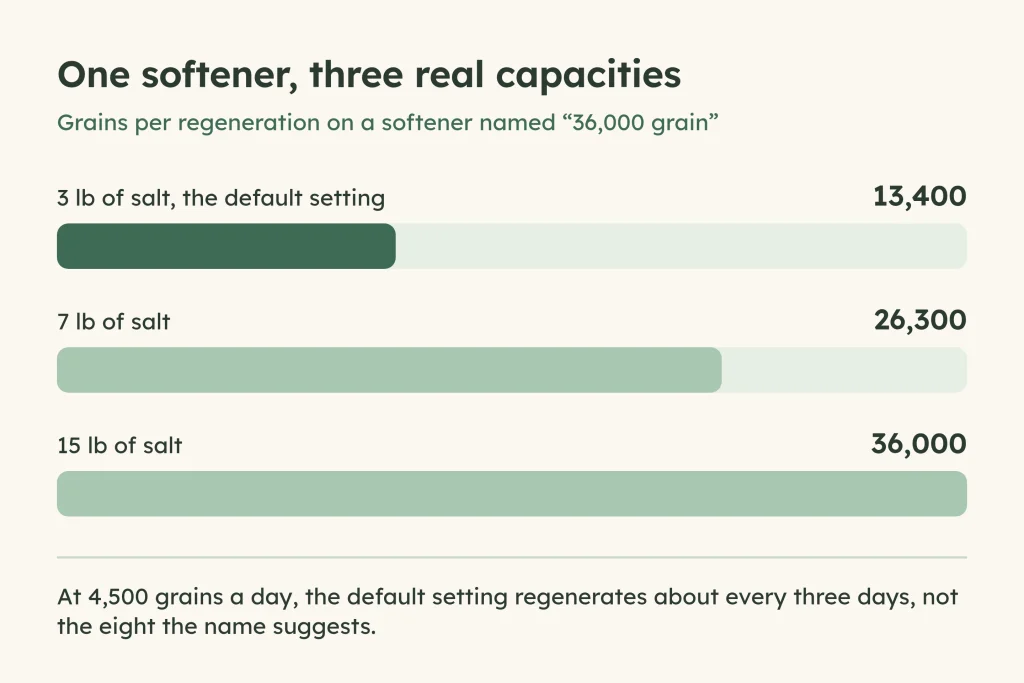
| A.O. Smith AOW-S400, “36,000 grain” | 13,400 at 3 lb | About 4,470 |
| A.O. Smith AOW-S400 | 26,300 at 7 lb | About 3,760 |
| A.O. Smith AOW-S400 | 36,000 at 15 lb | 2,400 |
| A.O. Smith AOW-S500 (same manual), “50,000 grain” | 26,400 at 6 lb | 4,400 |
| A.O. Smith AOW-S500 | 50,000 at 15 lb | About 3,330 |
Look at the first A.O. Smith row. The manual lists High Efficiency as the default setting, and on that setting a “36,000-grain” softener gives 13,400 grains per regeneration. That saves salt. But in a home using 4,500 grains a day, it regenerates about every three days, not the eight that the name suggests. Neither maker is hiding anything: the numbers are in the manual. Many sizing guides simply divide by the name.
EPA’s May 2026 softener guide says a 32,000-grain softener “can remove 32,000 grains of hardness in a cycle”. That’s true at the salt setting behind the rating. Resin data shows what that setting is: ResinTech’s CG8 table reaches 33,000 grains per cubic foot only at 15 lb of salt per cubic foot.
The formula and a worked example
The first part is the same arithmetic Penn State Extension uses. The difference is what you divide by at the end.
- Grains per day = (hardness in gpg + iron allowance) × gallons per day
- Grains needed = grains per day × (days between regenerations + reserve days)
- Resin needed = grains needed ÷ usable grains per cubic foot at your salt setting
- Round up to the next common size, then work out what that size really does
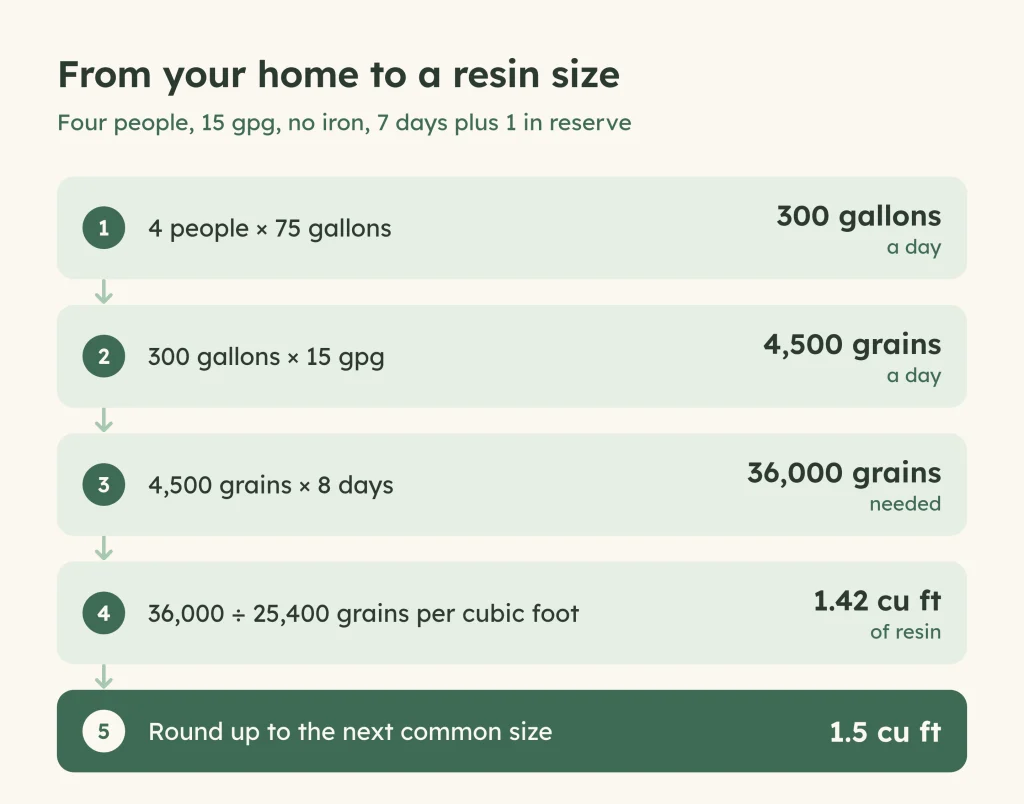
Take four people, 15 gpg, no iron, a 7-day target, 1 reserve day, and 7.5 lb of salt per cubic foot:
- Water: 4 × 75 = 300 gallons a day
- Load: 300 × 15 = 4,500 grains a day
- Needed: 4,500 × 8 = 36,000 grains
- Resin: 36,000 ÷ 25,400 = 1.42 cubic feet, so 1.5
- Capacity at this setting: 1.5 × 25,400 = 38,100 grains, or 7.5 days after the reserve
- Salt: 11.25 lb per regeneration, about 49 regenerations, about 550 lb a year, or 14 bags of 40 lb
A label-based guide would stop at 4,500 × 7 = 31,500 grains and choose a 32,000-grain softener. Here is what each choice does in that same home:
| Resin and setting | Usable grains | Days between | Salt each time | Salt per year |
|---|---|---|---|---|
| 1 cu ft at 15 lb per cu ft | 33,000 | 6.3 | 15 lb | About 860 lb |
| 1 cu ft at 7.5 lb per cu ft | 25,400 | 4.6 | 7.5 lb | About 590 lb |
| 1.5 cu ft at 7.5 lb per cu ft | 38,100 | 7.5 | 11.25 lb | About 550 lb |
| 1.5 cu ft at 5 lb per cu ft | 30,000 | 5.7 | 7.5 lb | About 480 lb |
The smaller softener can do the job, but running it at 15 lb costs about 310 lb more salt a year than the larger one at 7.5 lb. That’s about eight 40-lb bags, every year of the softener’s life. The extra upfront cost of more resin is yours to weigh in our total softener cost calculator.
Find your hardness
You need total hardness as calcium carbonate. Calcium alone is a different, lower number. City customers can start with the utility’s water quality report, as EPA’s guide suggests. If it gives a range, size for the high end. Well owners should test, and our well water test kit guide covers what else to test for at the same time. A hardness test kit is fine for a quick reading, but you’ll need a separate iron test.
Results in mg/L or ppm convert at 17.1 mg/L to 1 gpg. The calculator accepts both.
Check that you need a softener at all. EPA’s guide says water above 120 mg/L (7 gpg) is generally considered hard and softeners are often recommended above 180 mg/L or 10 gpg, and its fact sheet says to install one only where hardness is substantial or a local authority recommends it. Penn State says levels below 7 gpg probably won’t cause major scaling or soap film. Our guide to whether you need a softener goes through that decision.
Estimate your water use
Guides disagree on this figure. Penn State’s example uses 75 gallons per person per day, and Connecticut’s health department uses 300 gallons a day for a family of four, which is the same figure. Measured use is lower. The 2016 Residential End Uses of Water study, as tabulated by EPA, found 58.6 gallons of indoor use per person per day, including 7.9 gallons of leaks.
We default to 75 because it leaves room for guests and heavy weeks. Better numbers come from your own home:
- City water: take a winter bill, so that lawn watering isn’t counted, and divide the gallons by the days in the billing period. A bill already covers everyone in the home, so don’t multiply by people as well. If it’s in CCF, 1 CCF is about 748 gallons. Enter the result as metered household use.
- Well water: there’s no bill. Use the per-person figure, or fit an in-line water meter and read it over a normal week.
- Outdoor taps: EPA’s guide advises installing the softener after the line branches off to hose bibbs or irrigation where possible. If yours can’t be plumbed that way, use the bypass valve when you water.
Add iron if you have it
Dissolved iron shortens a softener’s run, so manuals tell you to raise the hardness setting. They don’t agree by how much. Rheem and A.O. Smith add 5 gpg per 1 ppm of ferrous iron. Hellenbrand adds 3, and the dealer Nelsen adds 4. Rheem’s example is 20 gpg plus 2 ppm of iron, entered as 30.
The calculator defaults to 5 because that’s the most common value in the manufacturer manuals we read. Enter your own manual’s figure if it differs, and if your softener has an iron setting, follow the manual. This factor is a rule of thumb, not chemistry. By equivalent weight, 1 ppm of ferrous iron is only about 0.1 gpg (Dow’s conversion table, our arithmetic), and we found no published explanation of the larger factor.
Limits vary just as much. Hellenbrand’s manual sets 2 ppm of ferrous iron. A.O. Smith lists 10 ppm and Rheem 11 ppm, and both carry a note about a 5 ppm Wisconsin limit. NDSU Extension says some softeners remove up to 10 ppm of iron and manganese. Only dissolved iron counts: Rheem says its softener won’t remove ferric or bacterial iron. If your water runs rust-colored, or your iron is near the limit, read our guide to removing iron from well water before you size anything. On iron water, set a shorter target: Rheem suggests forcing a regeneration every few days to keep the resin clean, and A.O. Smith’s manual says to leave its 96-hour override on. A.O. Smith also calls for resin bed cleaner every six months. Be careful with low salt settings too. Hellenbrand’s table says its efficient settings are for clean, iron-free water, and that above 0.5 ppm of iron a higher setting may be needed.
Manganese isn’t an input here. The manuals we read gave no factor for it, so we left it out rather than guess.
Pick a salt setting
The calculator uses the four capacities printed in ResinTech’s CG8 sheet, a resin sold for home and commercial softening:
| Salt per cu ft of resin | Usable grains per cu ft | Grains per lb of salt | Where it sits |
|---|---|---|---|
| 5 lb | 20,000 | 4,000 | Lines up with California’s 4,000 minimum |
| 7.5 lb | 25,400 | About 3,390 | Just above the 3,350 efficiency line |
| 10 lb | 29,000 | 2,900 | Below the efficiency line |
| 15 lb | 33,000 | 2,200 | Near the box number, at three times the salt of the top row |
Going from 5 lb to 15 lb triples the salt for 1.65 times the capacity. That’s why we default to 7.5 lb. EPA’s fact sheet tells buyers to look for more than 3,350 grains per pound, the same figure manufacturers cite as the NSF/ANSI 44 efficiency rating. California’s Health and Safety Code §116785 sets 4,000 grains per pound for softeners that discharge to a community sewer, which is why Rheem’s manual tells California owners to turn on its Salt Efficiency feature.
Low salt has a cost. A.O. Smith says its High Efficiency setting regenerates more often and uses more water. On the AOW-S400 that works out to about 1.6 gallons per 1,000 grains, against 1.0 on High Capacity (our division of its 21 and 25 gallons). Resin data also shows more hardness getting through at low doses, in Purolite’s C-100E sheet, which gives 4 to 10 lb per cubic foot as its standard range.
Resin figures also vary. ResinTech’s newer sheet says no engineering downgrade has been applied. Purolite starts at 31,700 grains at 10 lb, and its worked example comes down to 27,300 after corrections and a 90% design factor. Pentair’s Fleck 5600 SXT manual lists about 21,900 grains at 7.5 lb (our conversion from 50.2 g/L at 120 g of salt per liter), about 14% under ResinTech. Finished softeners with 1 cubic foot of resin land closer to ResinTech: Hellenbrand rates 22,930 grains at 6 lb and 28,060 at 10 lb, and A.O. Smith rates 26,300 at 7 lb. The dealer table at Nelsen rates a 32,000-grain tank at 24,000 grains on its efficient setting. So treat the result as a planning figure. The reserve day helps absorb the gap, and the manufacturer’s own rating, when you have it, beats ours. Enter it in the two optional boxes to see how that exact softener would run in your home.
These figures are for sodium chloride. If you use potassium chloride, A.O. Smith says to multiply compensated hardness by 1.12, and not to use it at all if the water has iron or manganese. Our guide to softener salt covers the choice.
Check peak flow
Grains tell you how long a softener lasts. Flow tells you whether it keeps up when several taps run at once. Pentair’s manual says to choose resin volume from the peak flow rate, because sizing on normal flow may lead to severe hardness leakage at peak.
Add up what your home runs at the same time. Federal limits cap new showerheads at 2.5 gallons per minute (gpm) and kitchen and bathroom faucets at 2.2 gpm, each at a set test pressure. So two showers and a kitchen tap come to at most 7.2 gpm, and your real fixtures may use less. Compare that with the softener’s rated service flow, not its intermittent figure. The AOW-S400 lists 7.5 gpm and the AOW-S500 7 gpm at a 15 psi drop, and the Rheem RHS42 lists 9.9 gpm at 12 psi. Rheem warns that sustained flow above the service rate may affect capacity and efficiency.

What changes the answer
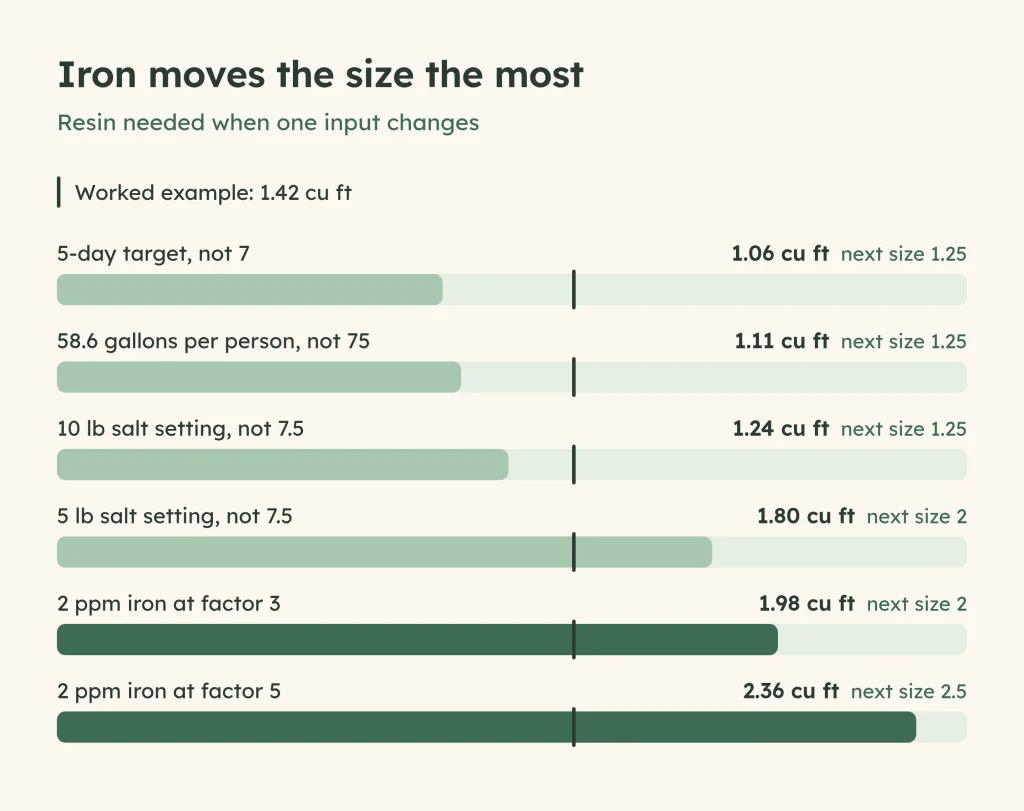
Starting from the worked example, which needs 1.42 cubic feet:
| Change | Resin needed | Next size |
|---|---|---|
| 58.6 gallons per person, not 75 | 1.11 cu ft | 1.25 cu ft |
| 5-day target, not 7 | 1.06 cu ft | 1.25 cu ft |
| 10 lb salt setting, not 7.5 | 1.24 cu ft | 1.25 cu ft |
| 5 lb salt setting, not 7.5 | 1.80 cu ft | 2 cu ft |
| 2 ppm iron at factor 3 | 1.98 cu ft | 2 cu ft |
| 2 ppm iron at factor 5 | 2.36 cu ft | 2.5 cu ft |
Iron matters most. If you’re between sizes, test for it first.
Too big or too small
Bigger isn’t automatically better. EPA’s guide warns that oversizing “will lead to inefficient use of water”, and a larger softener costs more to buy. A softener that’s too small regenerates often, and on a label-based choice it can also run out on a heavy day.
We found no official interval to aim for. Penn State’s example runs 6 to 7 days. Nelsen says 3 to 5, and Rheem’s controller can be set to force one at any interval up to 15 days. The “at least every 14 days” rule on many pages comes from sellers, and we found no extension or government source for it. Seven days with a day in reserve is a sensible middle, not a standard. If the calculator shows more than two weeks between regenerations, your load is small for even a 0.75 cubic foot softener. Check what your manual says about idle time, because the yearly salt figure may then read low.
All of this assumes demand-initiated regeneration, where a meter or sensor triggers the cycle. EPA says to avoid time-initiated models, and Wisconsin generally requires demand control on softeners that discharge brine (SPS 382.40(8)(j), third-party copy). A timer regenerates whether the resin is used up or not, so these salt figures won’t apply.
What to ask before you buy
- How many cubic feet of resin? Labels aren’t standard. Rheem’s 42,400 comes from 1.20 cubic feet, more than 32,000 a foot.
- What is the rated capacity at the salt setting I’ll use? Get grains and pounds from the same line of the manual.
- What is it set to when installed? A default of 3 lb and one of 15 lb are very different softeners.
- Is it certified to NSF/ANSI 44, with the efficiency rating? EPA recommends this. Rated efficiency is measured in the lab, and Rheem’s manual says real-world efficiency is typically lower.
- How much water does it use per 1,000 grains? EPA’s May 2026 figures differ: the guide says efficient softeners can use 4 gallons or less, then tells buyers to look for 5 or less, and the fact sheet says 4. EPA’s 2023 sheet gives 5.0 as the NSF/ANSI 44 rating. EPA says a typical softener uses 20 to 70 gallons per regeneration, so multiply by the regenerations per year in your result.
- What is the rated service flow, and at what pressure drop? Compare it with your peak.
- Is a softener allowed here? EPA says some local jurisdictions prohibit them, and it tells septic owners to check with the system’s manufacturer or a local service provider first.
What this calculator can’t tell you
It sizes for hardness and dissolved iron only. EPA says softeners do not typically treat other contaminants, so a softener doesn’t make well water safe. Take well test results that concern you to your state or county health department or a certified lab.
Softening adds sodium: about 8 mg/L per gpg removed, per NDSU Extension, so 15 gpg water gains about 120 mg/L. The calculator shows this number. If you’re on a sodium-restricted diet, ask your doctor. Results above 3 cubic feet are larger than the softeners in this article, so have a water treatment professional look at the job. WaterPlain has no lab and has not tested any softener: these figures come from published manuals and data sheets, and models named here are examples, not recommendations.
This page is general information, not medical or professional advice. We check every figure against the sources linked above. Facts checked against primary sources on 2 November 2026.
Formulas and sources
- Hardness in gpg: Connecticut DPH: Hard water and softeners, Publication 29, Nov 2023
- Compensated hardness: Rheem RHS42 softener manual: iron compensation and rated capacity at each salt dose
- Gallons softened per day: Penn State Extension: Water Softening (sample calculation)
- Grains removed per day: Penn State Extension: Water Softening (sample calculation)
- Grains needed per regeneration, with reserve: Pentair Fleck 5600 SXT installer manual, sizing and fixed reserve
- Usable grains per cu ft at this salt setting: ResinTech CG8 spec sheet, operating capacity table, rev. 2/27/2012 (distributor copy)
- Resin needed: ResinTech CG8 spec sheet, operating capacity table, rev. 2/27/2012 (distributor copy)
- Next common resin size: Nelsen: Softener sizing (tank sizes and capacities; trade source)
- Typical nameplate grains for that resin: Culligan: What size water softener do I need? (1 cu ft of resin, about 32,000 grains; seller)
- Usable grains at this salt setting: ResinTech CG8 spec sheet, operating capacity table, rev. 2/27/2012 (distributor copy)
- Days between regenerations: Penn State Extension: Water Softening (sample calculation)
- Salt per regeneration: ResinTech CG8 spec sheet, operating capacity table, rev. 2/27/2012 (distributor copy)
- Regenerations per year: Penn State Extension: Water Softening (sample calculation)
- Salt per year: ResinTech CG8 spec sheet, operating capacity table, rev. 2/27/2012 (distributor copy)
- Sodium added to softened water: NDSU Extension WQ1031: Water Softening (Ion Exchange), revised May 2022
- Days between regenerations on the softener you entered: Penn State Extension: Water Softening (sample calculation)
- Salt per year on the softener you entered: Rheem RHS42 softener manual: iron compensation and rated capacity at each salt dose
- Resin capacity at 5 lb salt per cu ft (20000, as of 2012-02-27): ResinTech CG8 spec sheet, operating capacity table, rev. 2/27/2012 (distributor copy)
- Resin capacity at 7.5 lb salt per cu ft (25400, as of 2012-02-27): ResinTech CG8 spec sheet, operating capacity table, rev. 2/27/2012 (distributor copy)
- Resin capacity at 10 lb salt per cu ft (29000, as of 2012-02-27): ResinTech CG8 spec sheet, operating capacity table, rev. 2/27/2012 (distributor copy)
- Resin capacity at 15 lb salt per cu ft (33000, as of 2012-02-27): ResinTech CG8 spec sheet, operating capacity table, rev. 2/27/2012 (distributor copy)
- mg/L as calcium carbonate in 1 grain per gallon (17.1, as of 2023-11-01): Connecticut DPH: Hard water and softeners, Publication 29, Nov 2023
- Sodium added, mg/L per gpg of hardness removed (8, as of 2022-05-01): NDSU Extension WQ1031: Water Softening (Ion Exchange), revised May 2022
- Typical nameplate grains per cu ft of resin (32000, as of 2026-11-02): Culligan: What size water softener do I need? (1 cu ft of resin, about 32,000 grains; seller)
Sources
- EPA WaterSense: Soften Water Without Wasting It, guide, May 2026
- EPA WaterSense: water-efficient home water softeners fact sheet, May 2026
- EPA WaterSense: water softeners tech sheet, 2023
- EPA WaterSense Specification for Homes v2.0, supporting statement (REUW 2016 table)
- Penn State Extension: Water Softening, updated 8 September 2025
- NDSU Extension WQ1031: Water Softening (Ion Exchange), May 2022
- Connecticut DPH: Hard water and softeners, Publication 29, November 2023
- 10 CFR 430.32: faucet and showerhead limits
- ResinTech CG8 spec sheet, rev. 2/27/2012 (distributor copy)
- ResinTech CG8 product data sheet, rev. 1.3 (distributor copy)
- Purolite C-100E data sheet (reseller copy)
- Dow DOWEX Water Conditioning Manual (distributor copy)
- Pentair Fleck 5600 SXT installer manual, 2016 (distributor copy)
- Rheem RHS42 softener manual
- A.O. Smith AOW-S400 and AOW-S500 manual
- Hellenbrand E3 softener manual (third-party copy)
- California Health and Safety Code §116785 (California Legislative Information)
- Wisconsin Admin. Code SPS 382.40 (Cornell LII copy)
- Nelsen: softener sizing (dealer, context)
- Culligan: what size water softener do I need (seller, context)