A salt-free water softener does not soften water. It leaves the calcium and magnesium in place and tries to stop them from forming scale. That can be a fair trade if your main problem is scale in pipes and water heaters and a brine softener isn’t an option. It is a poor one if you want slick-feeling water, easy lather and cleaner glass, because we found no independent study showing these units deliver that.
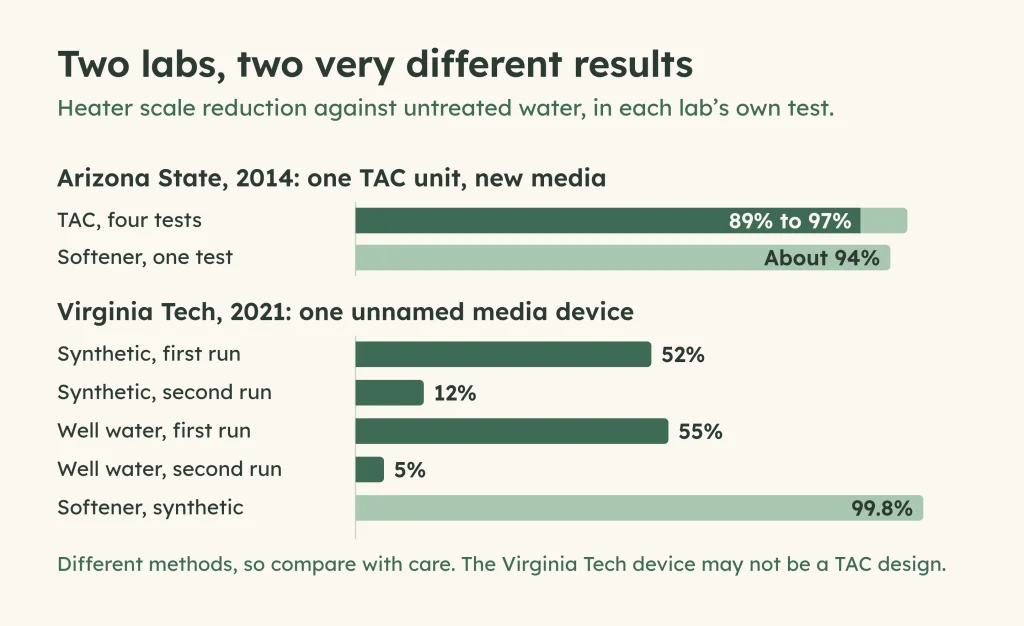
The evidence is better than critics admit and weaker than sellers claim. In one lab study a template-assisted unit cut heater scale by 89% to 97%. In another lab, a media device fell from over 50% to about 5% to 12% on its second five-day run. This guide, part of our water softener guides, sets out what each type does, what the studies found, which water rules them out and what they really cost to run.
WaterPlain has no lab and has tested none of these products. Everything here comes from published studies, certifications and makers’ own documents.
The short version
- What it does: the best-studied type, template-assisted crystallization (TAC), can sharply reduce scale inside water heaters, at least while the media is fresh and the water is within the maker’s limits.
- What it doesn’t do: meaningfully lower your hardness reading, improve lather, end spots and film, remove iron, or make water safer to drink.
- What can go wrong: iron, manganese, copper and phosphate can coat or interfere with the media. A city water supply can have some of these too, not only a well.
- Proof to ask for: a certificate to IAPMO/ANSI Z601 for that exact model, with the tested percentage. A figure on a sales page is not proof.
- Cost: no salt, but media and filters wear out. Over 10 years, a salt-free unit can cost more than a softener.
What “salt-free” really means
EPA describes a softener as a unit that removes calcium and magnesium by exchanging them for sodium or potassium. A salt-free device doesn’t do that. Nebraska Extension calls these products “descalant devices as opposed to hardness removing devices”.
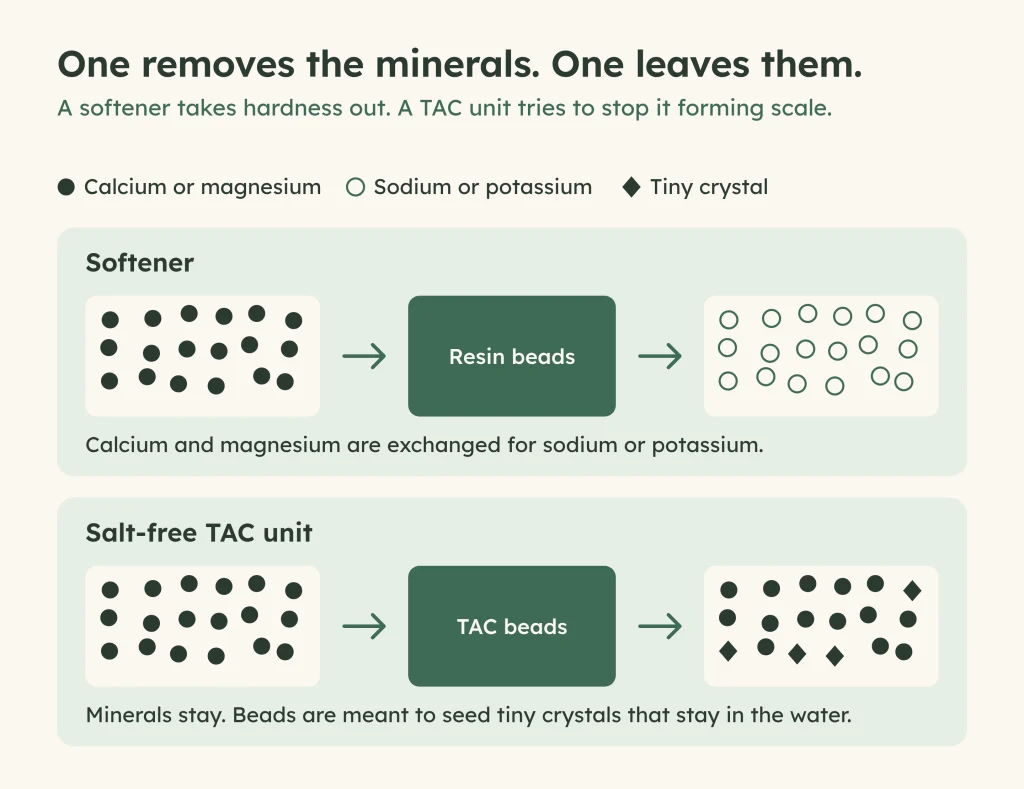
Many makers say the same in their technical papers, whatever the product name says. Watts writes that its OneFlow system “is not a water softener”. Aquasana says its conditioner won’t demineralize your water. A Pentair manual shows how the wording can slip: it opens with “You will experience naturally soft water immediately after the installation”, then says on the same page that the system “does not physically remove the natural minerals from the water.” Trust the second sentence.
A test kit shows this plainly. Virginia Tech says hardness before and after treatment is not changed by magnetic and electrical devices. TAC comes close to that: a University of Waterloo thesis measured drops of 2.7% to 4.4% for calcium and 4.0% to 6.9% for magnesium, too small to be of much practical value. So a hardness test can’t tell you whether one is working. For what real softening changes, see hard water vs soft water.
One common mix-up: a softener filled with potassium chloride is not salt-free. It is still an ion exchange softener, and it still flushes brine.
The types sold as salt-free
“Salt-free softener” covers very different products. Scale reduction below is against untreated water in the same test. The two main studies used different methods, so compare their figures with care.
| Type | How it is meant to work | Scale reduction found | Upkeep |
|---|---|---|---|
| TAC or NAC media tank | Beads seed tiny crystals that stay in the water | 89% to 97% for one unit. See the next section for results that disagree | Replace media: every 3 years (Watts), 2 to 10 years by model (Aquasana) |
| Phosphate cartridge | Media is used up as it treats the water | 54% in synthetic water, 80% in well water | Replace the cartridge |
| Citric acid cartridge | Media is used up as it treats the water | 47% and 73% in the same study | Replace the cartridge |
| Magnet or clamp-on electronic unit | Field said to change how minerals crystallize | About 50% for one electromagnetic unit (Arizona). 5% to 28% for a magnet, which showed slightly more scale with phosphate present, and 4% to 16% for an electric field unit (Virginia Tech) | Little or none |
| Electrically induced precipitation | Current pulls scale onto an electrode | About 50% (Arizona) | Electrode cleaned and flushed, about every 800 gallons in the unit tested |
| Electrochemical deionization | Electricity removes hardness ions | 97% to 99.9% (Virginia Tech). In Arizona’s one test of a capacitive unit, the report’s ratio table implies 83% and its scale weights about 96% | Electricity and a waste stream |
Of these, only the last is a real way to lower hardness without salt. Nebraska says such systems can reach under 5 grains per gallon (gpg) but struggle to get below 1. The Arizona report noted in 2014 that they weren’t as readily available to homeowners as the other types.
On magnets, Nebraska is blunt: “unproven technology without a strong scientific basis.”
What the studies show
Seller pages that cite a study often cite the first one below, and only its headline number. Here are the four we could read, with what limits each.
| Study | Setup | Result | Keep in mind |
|---|---|---|---|
| Arizona State and HDR for the WateReuse Research Foundation (2014). Funded by Phoenix, Scottsdale and other water agencies that want less salt in wastewater | One TAC unit, 700 gallons over 21 days. Four tests on waters of about 150 to 500 mg/L (about 9 to 29 gpg), at 80 °C (176 °F) and once at 60 °C (140 °F) | TAC cut scale by 89% to 97%. A softener cut it by about 94% in the one test where it ran. The lowest TAC result came on the hardest water | New media, three weeks. Measured heater scale only, not spots or film |
| Virginia Tech, peer reviewed (2021). Paid for by the Water Quality Research Foundation, the research arm of the Water Quality Association trade group, and Spring Point Partners. Authors report no competing interests | Six-gallon electric heater, five-day runs. Synthetic water at 320 mg/L (about 19 gpg) and private well water at 410 to 451 mg/L (about 24 to 26 gpg) | A “media-induced precipitation” device cut scale by 52% then 12% in synthetic water, and 55% then 5% in well water. A softener reached 99.8% in synthetic water; it wasn’t run on the well water | The paper doesn’t name the product or call it TAC. It removed calcium at first, which TAC isn’t meant to do, so it may be a different design (our reading). The authors call the results illustrative and say other products in a category may differ |
| Peter Fox of Arizona State for the Region of Waterloo (2015) | Two TAC units at a pumping station, run so one day equaled about 38 days of use in a three-person home. Measured free calcium, not scale | One unit declined within about a year’s equivalent, its media coated in manganese oxide. The other still met the target at about 4.5 years’ equivalent. A rerun with fresh media reached about 4.4 years on the first unit, from a much weaker start; a failed flow meter ended the second early | Installed just after chlorination, which may have sped up fouling. The author wasn’t sure it would happen in homes. A faulty calcium electrode also left readings from about day 17 to day 36 of the first run hard to interpret |
| University of Waterloo thesis (2019) | One Watts tank model on city waters of 169 and 640 mg/L (about 10 and 37 gpg). Kettles boiled treated and untreated water side by side | Free calcium fell 4% to 5%. Treated water formed slightly less scale, but visible scale still formed | A boiling kettle runs hotter than a home water heater, so this is a harsh test (our reading). The author asked for flow-through testing on new and used media |
The closest thing to a home trial came from the same region. Waterloo and Guelph put TAC units in 18 homes that had softeners, in an area where hardness runs from 17 to 38 gpg, for a year. One family dropped out. Of the other 17, 13 kept the unit: 3 noticed little change, and 10 did more wiping, used more vinegar and kept it anyway. Four had it removed, citing film on marble and glass and a dishwasher that no longer cleaned well. The units were free and participants were paid about C$400, so read that as a measure of acceptance, not of scale.
Our reading: TAC can cut heater scale sharply when the media is new and the water suits it. Whether that lasts for years in your home isn’t established. We found no independent long-term study that measured scale inside home water heaters. Nebraska’s December 2025 guide reaches a similar view, saying few conclusive studies confirm these devices work in homes and that consumers can’t tell for certain which products best reduce scale.
What it will not do
- Lower your hardness. The minerals stay, so a test reads about the same.
- Improve lather. Nebraska says no independent studies confirm which technologies help soap and detergent. Aquasana promises “no soap lather change”. Pentair’s manual claims most detergents work better but expects “very little improvement” with bar soap.
- End spots and film. Pentair says to expect fewer spots than untreated water but more visible ones than softened water. Aquasana says calcium spots can still form where water evaporates.
- Stop every kind of scale. Watts says its media does not reduce silica scaling. In the Waterloo kettle test, visible scale still formed.
- Make water safer. Nebraska lists bacteria, lead, nitrate, pesticides and hydrogen sulfide among the things these devices do not manage. Watts warns against using its system on water that is microbiologically unsafe or of unknown quality without disinfection.
- Remove iron or manganese. They’re generally not designed for it, and those metals can ruin the media.
What it can do
- Reduce heater scale. This is the one benefit with real lab support, for TAC, and the results above vary.
- Avoid salt and brine. Watts lists no salt, no electricity and no wastewater for its tanks. For comparison, take a home using 300 gallons a day at 15 gpg. That is 4,500 grains a day, or about 490 pounds of salt a year at the 3,350 grains per pound EPA’s May 2026 softener sheet uses as its mark. It also means about 6,600 gallons of regeneration water at EPA’s suggested 4 gallons per 1,000 grains.
- Add no sodium. Connecticut’s health department says softening adds 46 ppm of sodium for every 100 ppm of hardness removed. At 15 gpg (257 ppm) that is about 118 mg/L, or about 28 mg in an 8-ounce glass. If you follow a restricted-sodium diet, ask your doctor whether that matters for you.
- Fit where brine can’t go. EPA notes some jurisdictions limit softeners. Connecticut’s septic standards, revised in September 2026, list the treatment wastewaters a septic system may take, and softener brine isn’t among them. California lets local agencies limit new softeners after findings and an independent salinity study. A unit with no discharge sidesteps these rules, though you should check the wording where you live.
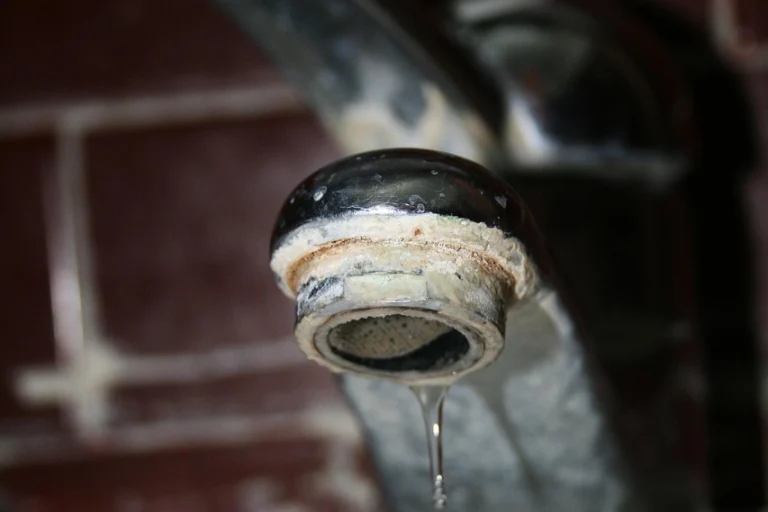
One warning if your pipes are already scaled. Pentair’s manual says old scale can loosen over the first few weeks, leaving grit in tubs and aerators, and suggests cleaning shower heads weekly for the first four weeks.
Will it work on your water?
Published limits differ widely between makers, so don’t rely on a general rule. These are three products’ own figures. Watts’ sheet covers its large-flow tanks and Pentair’s manual its high-flow model, so home models may differ.
| Limit | Watts OneFlow (spec sheet) | Pentair Pelican (manual) | Aquasana tankless unit (product page) |
|---|---|---|---|
| Hardness | 30 gpg recommended, effective to 75 | 75 gpg | Best below 15 gpg |
| pH | 6.5 to 8.5 | 7 to 11 | Below 8.3 |
| Iron | 0.3 ppm | Remove before the unit | Under 0.3 ppm |
| Manganese | 0.05 ppm | Remove before the unit | Not listed |
| Copper | 1.3 ppm | 1.3 mg/L | Not listed |
| Phosphate | Under 3.0 ppm | Under 1 mg/L | Not listed |
| Free chlorine | Under 2 ppm | Not listed | Not listed |
| Alkalinity | Not listed | Not listed | Under 250 mg/L |
| Water temperature | 40 to 100 °F | 36 to 120 °F | 40 to 90 °F |
Note the spread on hardness: 15 to 75 gpg. Watts explains its lower figure as a matter of appearance, since soft residue can form outside the plumbing above 30 gpg. The film complaints from the home trial above, in an area of 17 to 38 gpg, fit that warning, though the report doesn’t link them to each home’s hardness.
The phosphate catch
Pentair says phosphates “sequester dissolved hardness molecules, preventing them from forming crystals” and may coat the media. Many utilities add phosphate to control lead and copper corrosion. A 2023 study found that only 3% of US public water systems did so in 2015, but they served 25% of the population, mostly through larger systems. Virginia Tech could not test its media device with phosphate in the water because of maker constraints, so that study gives no result for that case.
So ask your utility whether it adds phosphate and at what level. Check the units, because 1 mg/L as phosphorus equals about 3 mg/L as PO4. Then compare the figure with the maker’s limit, and get the answer in writing.
Manganese, even at low levels
The Waterloo pumping station test is the warning here. One unit’s media fouled with manganese at about 0.04 mg/L, under the maker’s 0.05 limit, though the chlorination point may have made that worse. Watts says public supplies rarely, if ever, present a problem, and this was one. If your water report shows manganese near a limit, ask about pretreatment. Watts also says new copper lines should passivate for at least four weeks before a unit goes in.
Well water
Watts says most city water falls within its guidelines but untreated well water may pose a limitation, because hardness on a well often comes with other contaminants. Get a well water test first, covering iron, manganese, pH and bacteria. If results worry you, take them to your county or state health department, not to a seller.
Tankless water heaters
This is a common reason to buy, and the one with the most money at stake. A Rinnai manual says heat exchanger replacement due to water quality damage isn’t covered. Its table appears to set 200 mg/L, about 11.7 gpg, as the hardness limit, though the online copy we read was jumbled, so check your own manual. It also says that in hard water areas “the water must be treated”, and names a third-party system, ScaleCutter, as one option.
A conditioner leaves measured hardness about where it was, so a lab report on your water would show much the same number. Navien does give credit to media of this kind, but only its own. It adds a year of labor warranty when a new PeakFlow A or C goes in with a new Navien heater, and says PeakFlow C media “does not have a grain removal capacity”. We found no maker’s statement that a third-party TAC unit satisfies a hardness limit. Ask the heater’s maker in writing before you rely on one, and check that any Z601 result was earned on a tankless heater.
Certifications worth asking for
EPA’s 2024 WaterSense guide tells buyers to choose a softener or conditioner certified to NSF/ANSI 44 or IAPMO/ANSI Z601. NSF/ANSI 44 is the standard for cation exchange softeners, so a salt-free unit’s route is Z601.
- IAPMO/ANSI Z601: the only US performance standard we found for scale reduction devices. The December 2025 edition, which IAPMO lets anyone read online, requires 70% or greater scale reduction against untreated controls. The base test is 10 days and about 4,800 gallons on synthetic water of about 26 gpg, or more if the maker publishes a larger capacity, and the standard itself says actual results may vary. A short test says little about media life, so read the rated capacity too. The tested result must be marked on the device, in a form such as “IAPMO Z601 – 72%”, and the product literature must say whether it was earned on a tank or tankless heater.
- DVGW W 512: a German test that seller pages often cite. It has been withdrawn, and the publisher points to DIN 3607-2 (2023) instead. A test “based on” W 512 is not the same as passing it. Watts, for instance, describes testing “under protocol based on” W 512 for its claim of over 95%.
- NSF/ANSI 61, 372 and 42: these appear on many labels. NSF/ANSI 61 covers materials and 372 covers lead content. They say nothing about scale. NSF/ANSI 42 listings on salt-free units we saw covered chlorine taste and odor and structural integrity.
Sources do conflict. Virginia Tech wrote in December 2024 that no recognized US agency has set a protocol for physical water treatment devices, and Nebraska says standards are still being developed, while EPA points to Z601. Our view is that a Z601 certificate is the best proof on offer, and that it covers scale only. Some products claim it: Atlas Filtri’s data sheet says one media system is Z601 certified at up to 86%. That is the maker’s statement. We did not confirm it in a directory, so check the certifier’s listing for your exact model. The Watts, Pentair and Aquasana documents we read cite no Z601 certificate, and our searches found no TAC tank claiming one.
What it really costs
We found no independent 2026 price survey for salt-free units, so these are dated listings, and local quotes will vary. The current listings exclude installation.
| Item | Salt-free media unit | Salt softener |
|---|---|---|
| Hardware | $399.99 for Aquasana’s small tankless unit and $1,758 for its whole-house system, rated for up to 10 years or 1,000,000 gallons (maker’s pages, 2 Nov 2026). Older figures for whole-house units: $750 to $1,750 in the Arizona report’s 2012 quotes, and about C$1,500 retail in the Waterloo study | $500 to $1,500 (Penn State, September 2025) |
| Yearly consumable | Media. Watts says every 3 years. Its 12 gpm replacement media was $844 at one seller on 2 Nov 2026, and carried a $1,267 list price at a distributor that day, so $281 to $422 a year. Aquasana’s tankless replacement is $199.99 every 2 years. Its whole-house system takes pre-filters every 2 months and a post-filter every 6, about $148 a year at $36.99 a pack or cartridge | Salt. About 12 40-pound bags at $7 to $10 a bag, or about $110 a year at $9, for the 15 gpg example above |
| Water | None | About 6,600 gallons a year in that example |
| Drain and power | None | Needs a drain and usually an outlet |
Worked example over 10 years for that same home. The first and last lines assume $1,000 of hardware to isolate running costs. Replace these figures with your own quotes:
- Salt-free tank with Watts media: $1,000 plus three media changes at $844 comes to about $3,500.
- Aquasana whole-house: $1,758 plus $148 a year in filters comes to about $3,200. That home is at the system’s 15 gpg guideline and reaches its 1,000,000-gallon rating in about 9 years, when a $1,548 replacement tank would be due, taking the 10-year total to about $4,800.
- Softener: $1,000 plus 10 years of salt at $110 comes to about $2,100, plus about 66,000 gallons of water at your rate.
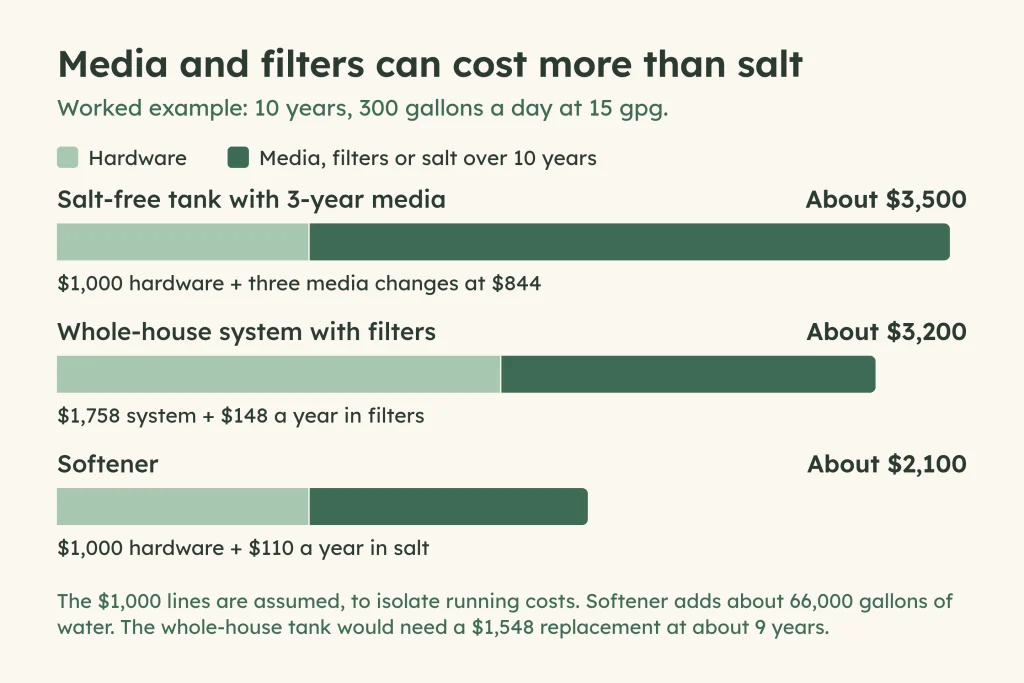
Treat that as a demonstration, not a verdict. Watts sells this media through distributors and one seller labels it commercial, so a home brand may charge less. Makers’ stated media lives run from 2 to 10 years, and we found no independent check of them in homes. Waterloo’s recruitment letter, written before its home trial, estimated C$125 to C$225 a year for TAC media lasting four years, against C$150 to C$300 for running a softener. The Arizona report’s 10-year model, built on 2012 vendor quotes, also favored TAC, at about $1,330 against about $3,480 for softeners, though two of its three TAC systems carried no yearly cost. Media and filter prices decide this, and many of the guides we read leave them out, so get them in the quote. To price the softener side with your own numbers, use our water softener cost calculator.
Should you buy one?
| Your situation | Where to start |
|---|---|
| You want soft-feeling water, good lather, fewer spots | A softener. None of the common salt-free units delivers that |
| Your hardness is under 7 gpg | Probably neither. Virginia Tech says treatment generally isn’t needed unless it’s causing a problem |
| City water in the maker’s limits, heater scale is the worry, and a softener is banned, unwanted or impractical | A Z601-certified unit is reasonable. A TAC tank without one rests on the studies above and the maker’s word |
| Water of about 17 gpg and up | Be cautious. TAC’s weakest Arizona result came on water of about 26 to 29 gpg, and the film complaints came from an area of 17 to 38 gpg |
| Well water with iron or manganese | Test, then treat those first, or use a softener rated for them |
| Phosphate-dosed city water | Get the level and the maker’s written limit first |
| Tankless heater near its hardness limit | Get the heater maker’s position in writing |
| Restricted-sodium diet | Ask your doctor. Salt-free adds none; softening only hot water is another route |
Our softener vs conditioner comparison goes further into the choice between the two.
Other ways to handle hard water
- Soften only the hot water. EPA suggests supplying softened water to a subset of uses, and Virginia Tech suggests softening only water to be heated if heater scale is the issue. Hot lines get the protection, and cold taps stay unsoftened.
- Portable exchange service. A company swaps resin tanks and regenerates them off-site, so no brine goes down your drain. California’s Water Code section 13148 does not limit portable exchange units. Availability varies by area.
- Live with it. Penn State says hardness under 7 gpg probably won’t cause major scaling. Connecticut suggests keeping hot water under 140 °F.
Before you buy
- Know your water. Get hardness, pH, iron, manganese and copper from your utility report or a test.
- Ask about phosphate. Your utility can tell you.
- Get the limits in writing for the exact model, not the product family.
- Ask for the Z601 certificate and look the model up with the certifier.
- Get the media price and interval, and ask how you’ll know it’s worn out. Waterloo’s participants said they couldn’t tell.
- Check your heater and dishwasher. Read the warranty, then ask about a conditioner in writing.
- Take a baseline. A hardness test can’t show the unit working. Clean an aerator and a shower head, note the date and photograph them, and check again after six months. If your heater is drained for service, note how much scale comes out.
General information, not medical or professional advice. Product details come from makers’ documents and may change, so confirm them for your model. WaterPlain sells nothing, takes no affiliate fees and has not tested these products.
Facts checked against primary sources on 2 November 2026.
Sources
- EPA WaterSense: Water Softeners technical sheet (July 2023)
- EPA WaterSense: home water treatment guide (November 2024)
- EPA WaterSense: water softener fact sheet (May 2026)
- Nebraska Extension G2275: Salt-Free Water 'Softener' Options (December 2025)
- Virginia Tech 442-664: Hardness in Household Water (December 2024)
- WateReuse Research Foundation: Evaluation of Alternatives to Domestic Ion Exchange Water Softeners (2014)
- Devine, Wang and Edwards: A Standardized Test Protocol for Evaluation of Scale Reduction Technologies (2021)
- Fox: NAC/TAC Performance Study for the Regional Municipality of Waterloo (2015)
- Metroline Research Group: A Salt-free Alternative to Residential Water Softeners (2019)
- Shen: University of Waterloo thesis on template assisted crystallization (2019)
- Watts: OneFlow OF1260, OF1465 and OF1665 specification sheet
- Watts: OneFlow OF844RM replacement media
- Watts: OneFlow FAQ (2026)
- Pentair: Pelican high flow salt-free system manual, reseller copy (2021)
- Aquasana: salt-free water conditioner for tankless water heaters
- Atlas Filtri: ROCK data sheet
- DIN Media: DIN 3607-2:2023-05
- Flint et al., Global Biogeochemical Cycles (2023)
- Connecticut DPH Publication 29: Hardwater Softeners Facts and Issues (November 2023)
- Connecticut DPH: Technical Standards for Subsurface Sewage Disposal Systems (September 2026)
- California Health and Safety Code 116786 (California Legislative Information)
- California Water Code 13148 (California Legislative Information)
- Rinnai C199i manual, third-party copy
- Navien: extra labor warranty with PeakFlow
- Penn State Extension: Water Softening (September 2025)
- Supreme Water Sales: OF0844RM listing ($844.08, 2 November 2026)
- Central Arizona Supply: Watts 0002155 replacement media list price (read 2 November 2026)
- IAPMO/ANSI Z601-2025: Scale Reduction Devices (read-only copy, December 2025)
- Aquasana: whole-house salt-free water conditioner
- Aquasana: tankless conditioner replacement
- Aquasana: 20-inch pre-filter 3-pack
- Aquasana: 10-inch post-filter
- Aquasana: whole-house conditioner replacement tank
- Navien: PeakFlow C