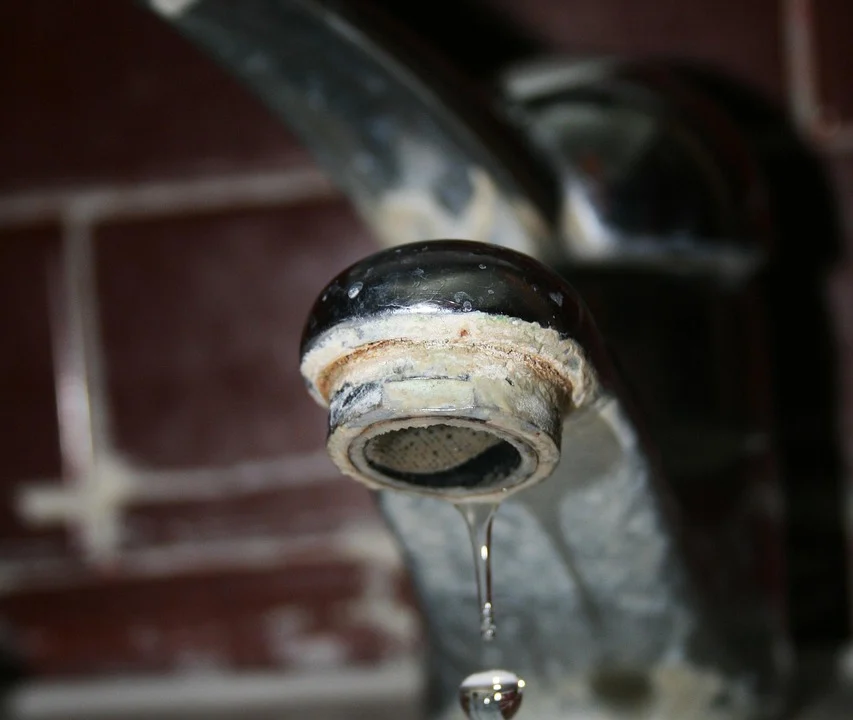
Hard water carries a lot of dissolved calcium and magnesium; soft water carries very little. That one difference decides how well soap lathers and how fast scale builds in your water heater. It does not decide whether your water is safe to drink. USGS calls water up to 60 mg/L as calcium carbonate soft and anything over 180 mg/L very hard, which is about 10.5 grains per gallon (gpg). Softened water is a third thing again: hard water with its calcium and magnesium swapped for sodium or potassium. This guide, part of our hard water hub, shows what each kind does in a real home, what the best-known water heater study measured and left out, what a softener costs you in salt and sodium, and how to decide from your own number.
This is general information, not medical or professional advice. WaterPlain has no lab: everything here comes from published sources, linked where we use them.
The short version
- Safety: hardness is an everyday nuisance, not a contaminant. EPA says hard water is not a health concern, and Connecticut’s health department notes there is no recognized standard or maximum contaminant level for it.
- Hard water’s real costs: soap scum, spotted glasses, clogged showerheads and scale in heaters.
- Softened water’s real costs: added sodium, salt to buy, water used to regenerate, and a machine to maintain.
- Where the line falls: Virginia Tech says levels under 7 gpg generally do not require treatment. EPA’s May 2026 fact sheet says to install a softener only with substantial hardness, such as above 180 mg/L or 10 gpg, or where a local water authority or code recommends one.
- First step: get your number before you shop. Everything below depends on it.
Hard, soft and softened water at a glance
| Hard water | Naturally soft water | Softened water | |
|---|---|---|---|
| Calcium and magnesium | High | Low | Mostly removed |
| Sodium | Whatever the source holds | Whatever the source holds | Raised by about 8 mg/L for each gpg removed, with salt-based softeners |
| Soap | Forms scum, needs more | Lathers easily | Lathers easily |
| Scale | Builds, above all when heated | Little | Little |
| Metal pipes | Scale. Excessively hard water can also corrode | Can corrode unless treated to stabilize it | Sources differ, see below |
| Drinking | No hardness limit | No hardness limit | Mind the sodium on a restricted diet |
“Soft water” means three different things
Most comparison pages treat soft water as one thing. It isn’t, and the World Health Organization says there are significant differences between naturally soft water and water softened at home.
- Naturally soft water is low in minerals to begin with, such as rainwater or a supply that never picked up much calcium. Seattle’s supply is an example, in the table below.
- Softened water started hard. Ion exchange pulls out calcium and magnesium and releases sodium in their place. EPA says nearly all home softeners work this way. The minerals are swapped, so softened water is not “pure” water.
- Demineralized water, such as distilled or reverse osmosis water, has most of its minerals removed. WHO notes that it tends to taste flat, and that bottlers often add minerals back for taste.
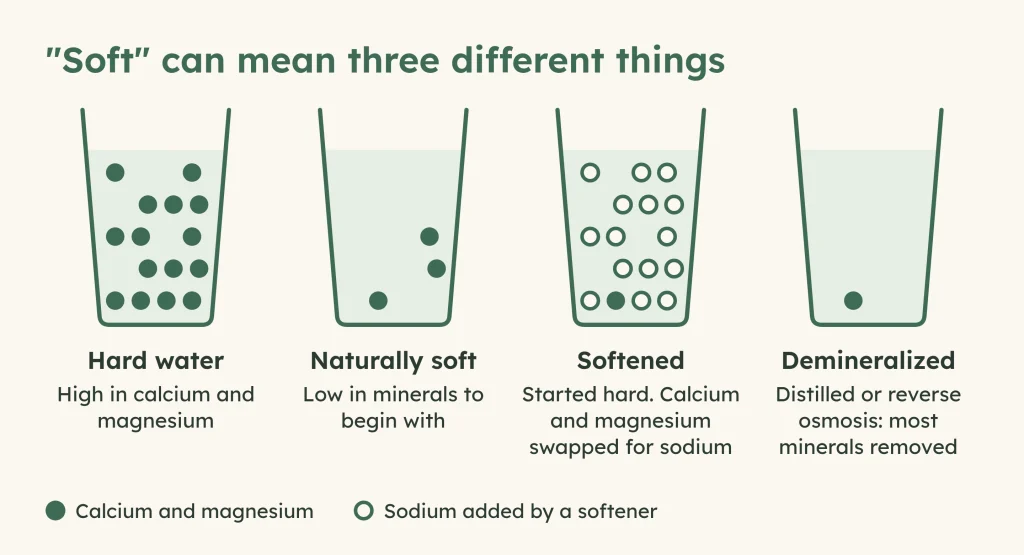
The labels matter because advice for one doesn’t carry over to another. The sodium a softener adds applies only to softened water, not to water that is soft from the source. Minnesota’s health department adds that soft water from a utility does not need more softening and that doing so may cause corrosion problems in your home.
The hardness scale, in gpg and mg/L
Hardness is reported as calcium carbonate, in milligrams per liter (mg/L, about the same as ppm) or grains per gallon. One gpg is 17.1 ppm. Two scales are in common use, and they only part ways at the low end.
| gpg | mg/L as calcium carbonate | USGS label | Extension label |
|---|---|---|---|
| Under 1 | Under 17 | Soft | Soft |
| 1 to 3.5 | 17 to 60 | Soft | Slightly hard |
| 3.5 to 7 | 61 to 120 | Moderately hard | Moderately hard |
| 7 to 10.5 | 121 to 180 | Hard | Hard |
| Over 10.5 | Over 180 | Very hard | Very hard |
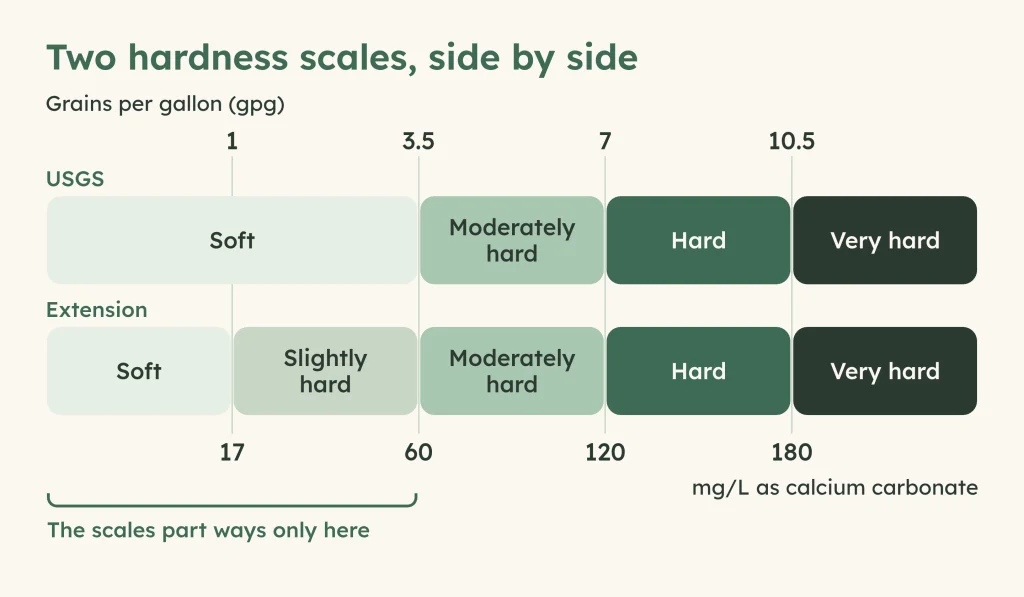
USGS column: USGS. Extension column: Penn State, matching Virginia Tech and North Dakota State. The gpg column for the USGS rows is our conversion. A lab report that lists calcium and magnesium separately is not showing total hardness yet. Our hardness converter works that out and handles the units.
Labels and irritation don’t line up perfectly. Our explainer on what hard water is covers the causes; for deciding, the useful numbers are these. North Dakota State, citing NSF, says consumers tend to see a problem once hardness passes about 6 to 7 gpg, and Connecticut’s health department historically recommended softening above 8.8 gpg.
What real US water looks like
EPA says hard water is most common in the Southwest and Midwest and in other areas that rely mainly on groundwater. The USGS national hardness map uses 1975 data and USGS says to read it at a national and regional scale only, so it can’t give you your own number. Utility reports can.
| Utility | Published hardness | USGS label |
|---|---|---|
| Seattle (samples of May 2022) | 1.24 to 1.41 gpg | Soft |
| Tampa (2024 average) | 10.8 gpg (185 mg/L) | Very hard |
| Phoenix (2025 report) | 10 to 17.6 gpg (172 to 302 ppm) | Hard to very hard |
| Las Vegas Valley (2026 report) | 16 gpg (280 ppm) | Very hard |
| Indianapolis and Morgan County (2025 data) | Average 19 gpg, range 8.7 to 27 | Hard to very hard |
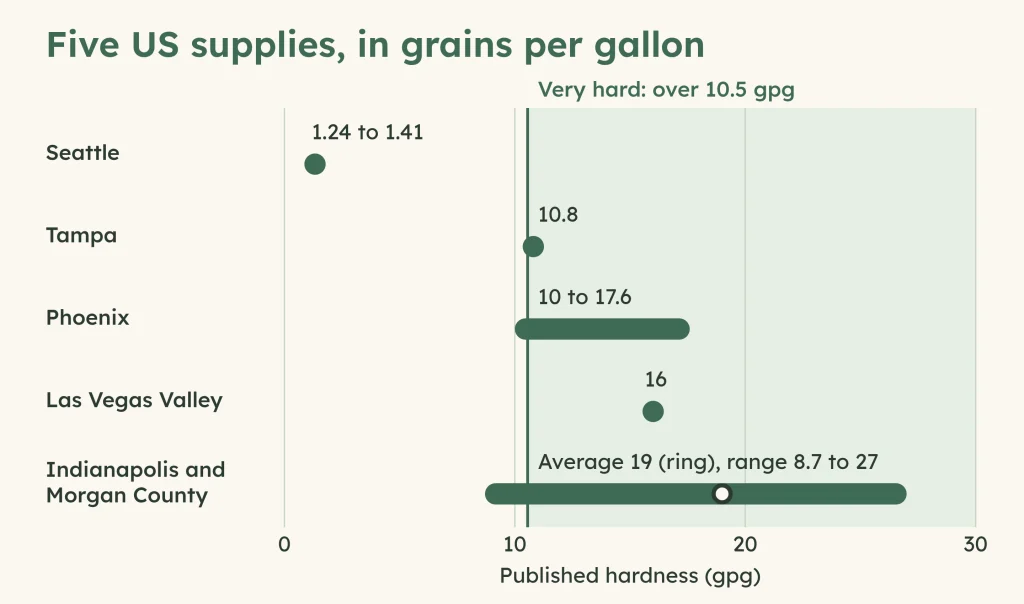
Look at the ranges. Indianapolis samples run from hard to more than double the very-hard line, so one citywide figure can mislead. Use the figure for your own service area if the utility splits it out. These five are examples we could confirm on the utilities’ own documents, not a ranking.
How to find your number
- On city water: read your annual water quality report. Suppliers must send one each year by July 1, and EPA has a search tool if you can’t find yours. Hardness is an unregulated item, so a report can leave it out. If yours does, call the utility.
- On a well: nobody has measured it for you. Connecticut advises a test by an approved lab so a softener can be sized properly. Well owners also need tests for things that have nothing to do with hardness, and our guide to well water test kits covers what to order.
- For a quick check: dip strips and drop kits exist, but Nebraska Extension warns that their accuracy varies. Our guide to water hardness test kits explains what each type can tell you.
What hardness does in your home
Soap, laundry and glassware
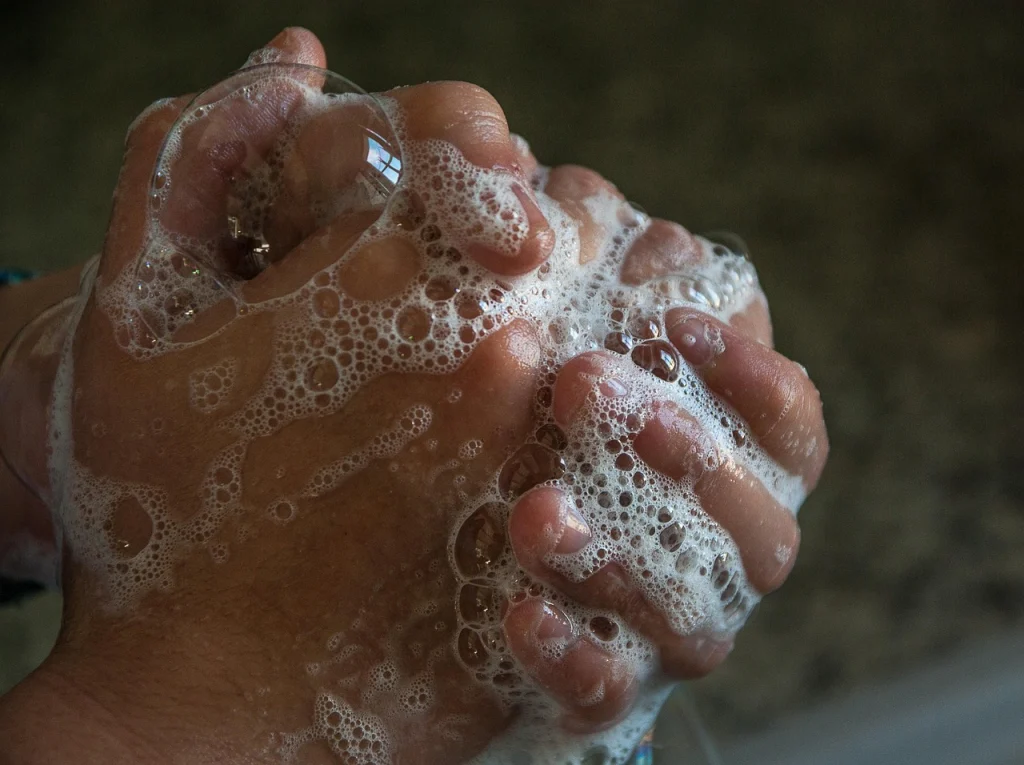
These are the effects you notice first. Soap reacts with calcium to form scum, so you need more soap or detergent to get things clean, and spots or film can stay on glasses. Nebraska Extension adds that laundry may turn dingy and gray over time and feel harsh. Sellers quote large detergent savings from softening. We could not trace those figures to a study we were able to read, so we don’t repeat them.
Water heaters: the study everyone quotes
Most of the energy-savings claims we read trace back to one Battelle lab study, run around 2009 and prepared for the Water Quality Association, the water treatment trade group. It tested 30 heaters on softened water and on well water at about 26 gpg, under accelerated conditions. Heater type changes the answer.
| Heater | Measured on 26 gpg water | Measured on softened water | Battelle’s estimate at 15 gpg over 15 years |
|---|---|---|---|
| Gas tank | Efficiency fell from 70.4% to 67.4% in 2 years’ equivalent use. About 528 g of scale a year | Efficiency stayed at 70.4%. About 7 g a year | $301 extra, or about $20 a year |
| Electric tank | Efficiency unchanged. About 907 g of scale a year | Efficiency unchanged. About 14 g a year | No extra energy recorded. Heating element life expected to be shorter, but not measured |
| Tankless gas | Efficiency fell from 80% to 72%, needing deliming at 1.6 years’ equivalent use | Efficiency stayed at 80% | $799 extra, or about $53 a year, of which $662 is deliming |
Those dollar figures assume 50 gallons of hot water a day, gas at $10 per mmBtu and $120 per deliming, and the yearly amounts are our division. They leave out what the softener itself costs. If your gas costs more, the energy part rises in proportion. The report’s summary table puts the gas tank saving at 6.6% at 10 gpg and 10.3% at 15 gpg, or roughly $7 to $10 for every $100 of gas used to heat water.
Four cautions. The test ran for 90 days, and its “years of equivalent use” are Battelle’s own calculation from heavier use, harder water and hotter settings. The 15 gpg figures come from equations built on the 26 gpg test, not from testing at 15 gpg. When a seller quotes a saving of up to 24%, that is the modeled gas tank figure at 30 gpg, harder than any supply in our table. And USGS says scale can lower the efficiency of electric water heaters, while Battelle measured no change, because the element sits fully in the water.
Our reading: on a gas or electric tank, energy savings alone are a weak reason to buy a softener. Tankless owners have a stronger case. Battelle estimates a tankless heater needs deliming about every 8.4 years at 5 gpg, every 2.7 years at 15 gpg and every 1.4 years at 30 gpg.
Showerheads, faucets and appliances
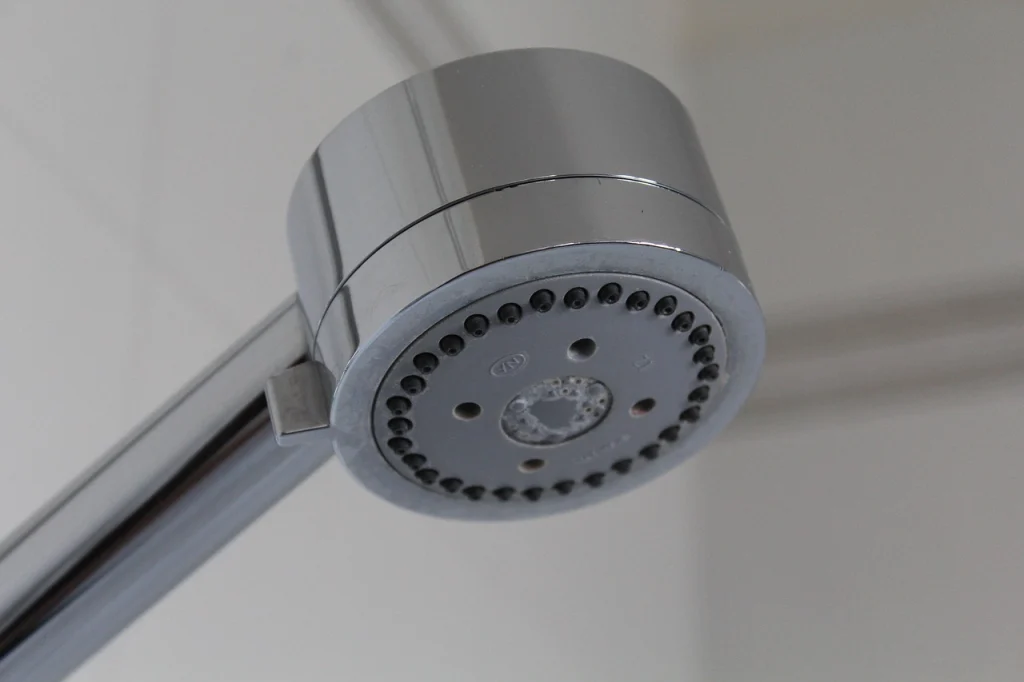
In the same study, low-flow showerheads on hot, unsoftened 26 gpg water clogged after an average of 3,203 gallons, and low-flow faucets after the equivalent of 19 days at 50 gallons a day, though Battelle thought the faucet scale had broken loose from plumbing upstream. All those on softened water finished without trouble. Dishwashers and washing machines on both supplies completed the 30-day test, but the units on hard water had noticeable scale on every wet surface. That is very hard water in an accelerated test, so don’t expect the same timing at 10 gpg.
Skin and hair: weaker evidence than the ads suggest
- Eczema: the best evidence we found is a randomized trial of 336 children in English hard-water areas. After 12 weeks, nurses who didn’t know which homes had softeners found no added benefit over usual care. Parents reported small improvements, which the authors put down to response bias, since families knew who had a softener. A smaller 2018 lab study of 80 people points the other way: skin washed in hard water held more residue of a common cleansing ingredient and showed more irritation, and softening reduced that. It was funded by Harvey Water Softeners, it measured skin reactions rather than eczema at home, and its authors say an intervention study is needed. Talk to a doctor about eczema rather than expecting a softener to treat it.
- Hair strength: two small lab studies disagree. One on hair from 15 women found no difference at about 212 ppm. Another on hair from 70 men found lower strength at about 487 mg/L, higher than any figure in our table. Neither settles anything for your bathroom.
- Feel: Nebraska Extension says hair washed in hard water may look dull and not feel clean. Many people also report a slick feeling after showering in softened water, but the explanations we found came from sellers, and we found no independent study of it.
Is hard water safe to drink?
As far as hardness goes, yes. USGS calls hardness “not a health concern”, and it appears nowhere in EPA’s secondary drinking water standards. Nebraska Extension sums it up: a nuisance, with no health need to remove it.
Is it better for you than soft water? That claim runs ahead of the evidence. USGS relays WHO’s view that drinking water may add useful calcium and magnesium, especially for people short of them. On heart disease, WHO’s background paper says the evidence for a protective effect is debated and does not prove cause, and it proposes no minimum or maximum level. On this evidence, health is not a good reason to keep hard water or to soften it. Decide on scale, soap, cost and sodium.
Taste is a matter of habit. WHO puts the taste threshold for the calcium ion at 100 to 300 mg/L, depending on what it is paired with, and says consumers accept higher levels.
One limit on all of this: a hardness result is a single number. It says nothing about lead, nitrate, bacteria or anything else, and a softener does not remove bacteria, lead, nitrate or pesticides, as we explain in our comparison of a water softener and a water filter. If someone is sick, or a well result worries you, go to your state or county health department or a certified lab, not to a product.
What softened water costs you
Sodium
A salt-based softener adds about 8 mg/L of sodium per gpg removed, and Penn State and Connecticut’s figures agree. That comes on top of whatever sodium your water already has. Here is what it means if you drink 2 liters a day of softened water, set against the 2,300 mg daily limit in the Dietary Guidelines for Americans. The sums are ours.
| Hardness removed | Sodium added | In 2 liters | Share of 2,300 mg |
|---|---|---|---|
| 7 gpg | 56 mg/L | 112 mg | About 5% |
| 10 gpg | 80 mg/L | 160 mg | About 7% |
| 15 gpg | 120 mg/L | 240 mg | About 10% |
| 25 gpg | 200 mg/L | 400 mg | About 17% |
For most people that is a modest share of a day’s intake, since FDA says Americans average about 3,400 mg. It matters more on a restricted diet. EPA’s guidance level of 20 mg/L is for people limited to 500 mg of sodium a day, and softening just 3 gpg adds more than that. EPA says not to apply it to the whole population. Its separate 2003 taste recommendation is 30 to 60 mg/L. Neither is an enforceable limit. If anyone at home has high blood pressure, Minnesota’s health department says to ask a doctor about drinking softened water.
Switching to potassium chloride cuts the sodium, but it isn’t automatically the healthy choice. It adds 76 ppm of potassium per 100 ppm of hardness removed, by Connecticut’s figures. WHO advises people with kidney problems, certain other illnesses or medications, older people and infants to seek medical advice first.
The simplest fix, recommended by Minnesota and described by Nebraska, is an unsoftened cold tap in the kitchen for drinking and cooking.
Salt and water: a worked example
Take a family of four on 15 gpg water, using Connecticut’s typical 300 gallons a day, with every gallon softened. That is 4,500 grains of hardness a day, or about 1.64 million grains a year.
- Salt: EPA advises models with more than 3,350 grains per pound of salt. At exactly that efficiency, the family uses about 490 lb a year, or about 12 bags of 40 lb.
- Water: EPA also advises models using 4 gallons or less per 1,000 grains. At that ceiling, softening takes up to 18 gallons a day, or about 6,600 gallons a year.
Those are EPA’s shopping thresholds, so a less efficient softener uses more of both. Sending less water through it uses less: Penn State notes that toilets and outside spigots can be left off the softened line, and Virginia Tech suggests softening only hot water if scale in the heater is your main concern.
Pipes, plants and local rules
- Pipes: sources differ. Minnesota warns that softeners can corrode pipes and contribute to elevated lead and copper, and says not to run one for at least the first few weeks with new copper plumbing. Connecticut says over-softened water can attack metal piping. WHO says softened water is “not necessarily corrosive”. We can’t resolve that for your house, because pH, alkalinity and your plumbing all play a part. In an older home, test your tap for lead and copper, softener or not.
- Plants: Nebraska Extension advises against repeatedly using softened water on plants, lawns or gardens because of the sodium. An unsoftened outdoor spigot solves this.
- Local rules: EPA’s advice begins with “if water softening is allowed where you live”, and discharge rules vary. Connecticut’s health department said in its 2023 fact sheet that softener backwash to a septic system is “specifically prohibited”, and softeners are not on the list of approved discharges in the state’s September 2026 technical standards. Nebraska notes that regeneration adds load to a septic system. Check with your town or county before you buy.
Which is better for your home?
Neither is better everywhere. A softener solves a nuisance and creates a smaller, ongoing chore, so the question is whether your nuisance is big enough. This table is our reading of the sources, not a rule.
| Your water | What the sources say | Sensible move |
|---|---|---|
| Under 3.5 gpg | Soft or slightly hard. Minnesota warns against softening soft utility water | No softener. Nothing to fix |
| 3.5 to 7 gpg | Virginia Tech: generally no treatment needed | Clean fixtures, use the fixes below |
| 7 to 10.5 gpg | Virginia Tech: treat only if it is causing you a problem. Below EPA’s example line | Your call. Lean toward a softener with a tankless heater or real scale trouble |
| Over 10.5 gpg | Above EPA’s example, which pairs 180 mg/L with 10 gpg, though 180 mg/L converts to 10.5 | A softener is reasonable if allowed locally. Price it first |
Our guide to whether you need a softener takes this further, including iron, sodium diets and septic homes. Penn State, on a page updated in September 2025, puts hardware alone at around $500 to $1,500. Local quotes vary, and our calculator for the full softener cost adds installation and yearly running costs.
Living with hard water, no softener needed
If you are in the middle range, try these first. The first three are from Connecticut’s list of non-treatment remedies; the fourth is from USGS.
- Use a detergent containing sequestering agents (polyphosphates) instead of soap alone.
- Keep hot water below 140°F, since scale forms when hard water is heated. This one comes with a conflict: CDC’s Legionella guidance for building water systems says to store hot water above 140°F. It isn’t written for single homes, but it is a reason to go by your heater’s manual, not to turn the setting down just to slow scale.
- Clean scale out of heater elements and boiler tubes, then flush. Follow your heater’s manual.
- Run vinegar through coffee makers to dissolve mineral buildup.
Salt-free conditioners are also sold as an alternative. They work differently from softeners, and our guide to salt-free water softeners looks at what they do and don’t do.
What to do next
- Get your hardness in gpg from your water report, your utility or a lab.
- Find it in the table above and list the problems you actually have.
- If you are on a well, test for safety before thinking about softness.
- If a softener still makes sense, check local rules, plan an unsoftened kitchen tap, and price it using a hardness figure from your utility or a lab.
Facts checked against primary sources on 2 November 2026. Every figure is checked against the linked source.
Sources
- USGS: Hardness of Water
- EPA WaterSense: Soften Water Without Wasting It, fact sheet 832-F-26-006, May 2026
- EPA: Drinking Water Advisory on Sodium, EPA 822-R-03-006, February 2003
- EPA: Consumer Confidence Report information for consumers
- eCFR: 40 CFR 143.3, secondary maximum contaminant levels
- FDA: Sodium in Your Diet
- WHO: Hardness in Drinking-water, background document, 2011
- WHO: Potassium chemical fact sheet
- Connecticut DPH: Publication 29, Hardwater-Softeners Facts and Issues, November 2023
- Minnesota Department of Health: Home Water Softening
- Penn State Extension: Water Softening
- Virginia Tech Extension: Household Water Quality, publication 442-664
- North Dakota State University Extension: Water Softening (Ion Exchange), WQ1031
- Nebraska Extension: G1491, Drinking Water Treatment: Water Softening (Ion Exchange)
- Battelle: Study on Benefits of Removal of Water Hardness, final report for the Water Quality Association (third-party archived copy)
- Thomas KS et al.: randomised controlled trial of ion-exchange water softeners for eczema in children, PLoS Medicine, 2011
- Srinivasan G et al.: Effects of Hard Water on Hair, International Journal of Trichology, 2013
- Luqman MW et al.: changes in strength of hair after deionized water and hard water, International Journal of Trichology, 2018
- Seattle Public Utilities: Quarterly Surface Water Analysis, samples of 17 May 2022
- City of Tampa: 2024 Water Quality Report
- City of Phoenix: 2025 Water Quality Report
- Las Vegas Valley Water District: 2026 Water Quality Report
- Citizens Energy Group: Indianapolis and Morgan County water quality data, 2025
- CDC: Monitoring Building Water (Legionella control), updated 26 March 2026
- Connecticut DPH: Technical Standards for Subsurface Sewage Disposal Systems, effective 1 September 2026
- Danby SG et al.: effect of water hardness on surfactant deposition and skin irritation, Journal of Investigative Dermatology, 2018