A water softener usually costs $500 to $1,500 for the hardware. Commercial estimates put a basic plumber-installed job at about $1,000 to $1,400, and reported dealer quotes run far higher. Running one adds roughly $150 to $190 a year with salt in our worked examples, or about $520 with potassium chloride. Those ranges are too wide to budget from, so the calculator uses your quote, your hardness and your water bill to give one number: what the softener costs over the years you keep it. Our costs and tools hub has the other calculators.
For Penn State’s example home at 10 grains per gallon (gpg) on city water, our worked example comes to about $3,200 over 10 years. The same softener on potassium chloride, at a $43 bag, comes to about $6,900. A $6,500 dealer system comes to about $8,300. The sections below show where each figure comes from and how to check a quote.
What a softener costs upfront
Prices depend mostly on who sells it. We found no government source for installed softener prices, so this table mixes public sources, which cover hardware, with commercial estimates, which cover the installed job. The commercial ones are labeled.
| What | Figure | Source and basis |
|---|---|---|
| Hardware only | $500 to $1,500 | Penn State Extension, September 2025. Repeated in its buying tips, July 2026 |
| Retail price | About $400 to $2,700 | NDSU Extension, May 2022, by size and type |
| Basic install, softener included | $1,131 to $1,405 | Homewyse, commercial estimator, May 2026, given as where the national average starts. A 20,000-grain city-water unit in easy conditions, without permits, sales tax or code work |
| Independent installer, modeled | $1,029 to $1,305 | TapWaterData, commercial site that earns affiliate commissions, 4 October 2026. A 32,000-grain unit, built from list prices and the BLS plumber wage |
| Independent installers, reported quotes | Median $3,450, range $1,200 to $6,250 (20 quotes) | TapWaterData, same page, quotes from 2024 to 2026, all from forums |
| National dealers, reported quotes | Median $6,500, range $3,224 to $15,000 (43 quotes) | TapWaterData, same page, quotes from 2024 to 2026: 22 forum, 9 review site, 12 Better Business Bureau |
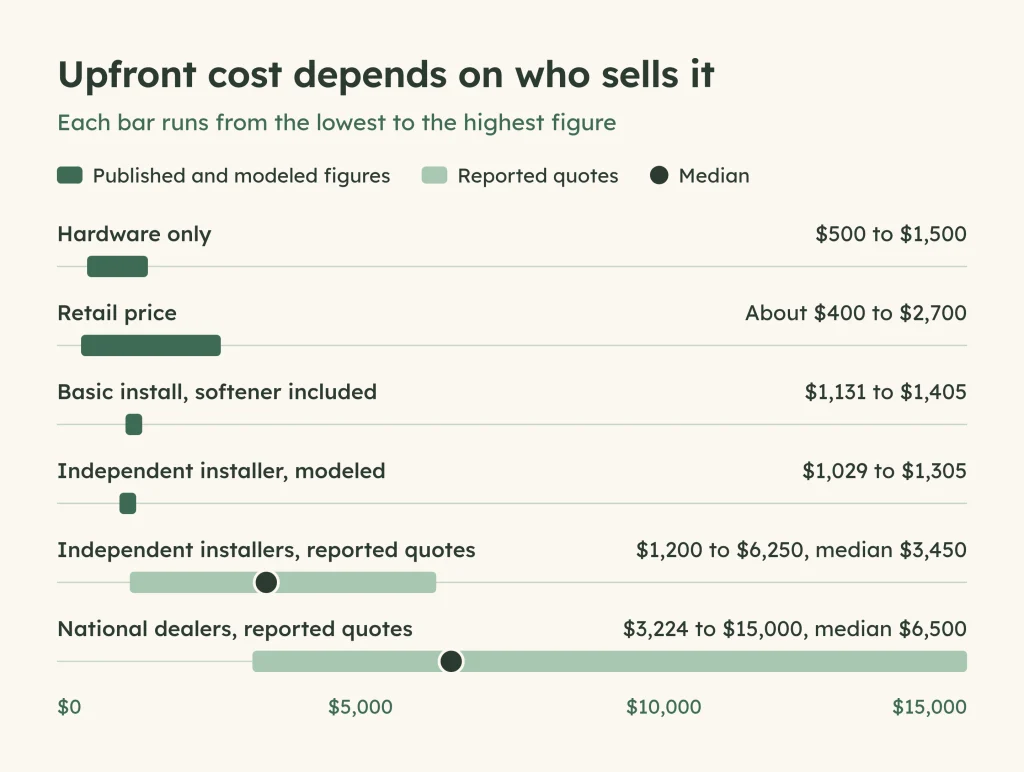
Treat the two quote medians with care. They are small samples of what people posted, several don’t say what the price included, and people who post may have paid more than most. Still, they show what the modeled figures miss: a softener job can be quoted at several times the estimator’s price.
First check that you need one. EPA suggests softeners where hardness is substantial, for example above 180 mg/L or 10 gpg, or where a local authority or health code recommends one. Test first with a water hardness kit or your utility’s water report.
What installation adds
Installation depends on the house more than the softener. Homewyse’s estimate assumes a two-hour minimum and an easy site. It leaves out repairs, relocation and bringing plumbing up to code. For scale, the median US plumber’s wage was $30.67 an hour in May 2025. A plumbing firm bills more than its wage.
Ask each installer to price these lines separately, then enter them under Extra site work:
- Tying into the main line, or a softener loop if the house has none
- A drain with an air gap, and a power outlet nearby
- Any permit your town requires
- Taking away the old unit
- A pre-filter, if the water has sediment or a whole-house filter comes first
Our water softener installation cost guide goes through each line and when fitting one yourself is reasonable.
What it costs each year
Salt depends on hardness, water use and the softener’s salt setting. In our example it costs about the same as the drain water. NDSU put a 40-pound bag at $5 to $10 in 2022, the latest extension figure we found. Store listings in our water softener salt guide ran about $7 to $10 in November 2026. We use $8 as the default, so check your shelf price.
Potassium chloride costs far more. NDSU gave up to $25 a bag in 2022, and that figure is out of date: one product page listed a 40-pound bag at $42.99 on 2 November 2026, and the listings in our salt guide ran about $35 to $50. We use $43. NDSU says about 10% more is used, and some sources say more, so the calculator asks you to add at least 10% to a potassium bag price: $43 becomes $47.30. Use your shelf price.
Water. A typical softener uses 20 to 70 gallons per regeneration, EPA says, and Penn State’s figure is about 50. EPA’s softener page says use can reach 10,000 gallons a year. EPA WaterSense’s estimate of the national residential average was $16.83 per 1,000 gallons of water and wastewater in 2024, so your own bill may differ a good deal. If you are on a private well and septic system, enter 0: you pay no utility bill for that water, but your septic system still receives it.
Electricity is small and left at zero by default. The Rheem RHS42 manual shows a 24-volt plug-in supply but no wattage, and we found no public measurement. TapWaterData’s stated upper bound is under $3 a month. Add it under Other yearly costs, along with any filter cartridges or service plan.
Repairs. We found no public agency figure for these. LatestCost, a commercial estimator, gave $300 to $900 for professional resin replacement in October 2026. We use $300 as an allowance across the period. That is our assumption, not a published figure, so replace it with your own.
The formula and a worked example
The calculator starts from the grains of hardness your softener has to remove, the same core math as Penn State’s sizing example. It assumes a softener that regenerates on demand, not on a timer.
- Upfront cost = softener price + installation + extra site work
- Hardness counted = hardness + (dissolved iron in ppm × 5)
- Grains per year = people × gallons per person per day × hardness counted × 365
- Salt pounds per year = grains per year ÷ grains per pound
- Salt cost = pounds ÷ 40 × bag price
- Drain gallons per year = grains per year ÷ 1,000 × gallons per 1,000 grains
- Water cost = drain gallons ÷ 1,000 × your rate
- Yearly cost = salt cost + water cost + other yearly costs
- Total = upfront cost + (yearly cost × years) + repairs
Take four people using 75 gallons each at 10 gpg, Penn State’s example home. That is 3,000 grains a day, or 1,095,000 a year. The $1,000 softener is the middle of Penn State’s range, and $1,400 in total sits inside Homewyse’s estimate.
- Salt at 2,900 grains per pound: 378 lb, or 9.4 bags, at $8 is $76
- Drain water at 4 gallons per 1,000 grains: 4,380 gallons at $16.83 per 1,000 is $74
- Running cost: $75.52 + $73.72 = $149 a year, or about $12 a month
- Upfront: $1,000 softener + $400 installation = $1,400
- Ten years: $1,400 + $1,492 + $300 repairs = $3,192, or $319 a year
The default of 4 gallons is cautious. It is the mark in EPA’s fact sheet for an efficient softener, though EPA’s guide and the voluntary NSF/ANSI 44 rating use 5. Penn State’s 50 gallons per 20,000-grain cycle works out to 2.5, which would make the water line about 2,740 gallons and $46.
Five homes compared
All five use four people, 75 gallons each, $8 salt unless noted, 2,900 grains per pound, 4 gallons per 1,000 grains, $16.83 water unless noted, and a $300 repair allowance over 10 years. These are examples, not quotes.
| Home | Upfront | Per year | 10-year total |
|---|---|---|---|
| Self-installed, low-end unit, 10 gpg, city water ($500 + $100 parts) | $600 | $149 | $2,392 |
| Plumber-installed, 10 gpg, city water | $1,400 | $149 | $3,192 |
| Same home on potassium chloride ($47.30 bag entry) | $1,400 | $520 | $6,902 |
| Well home, 20 gpg and 1 ppm iron, no water bill (larger $1,400 unit + $400 installation) | $1,800 | $189 | $3,988 |
| Dealer system at the $6,500 quote median, 10 gpg, city water | $6,500 | $149 | $8,292 |
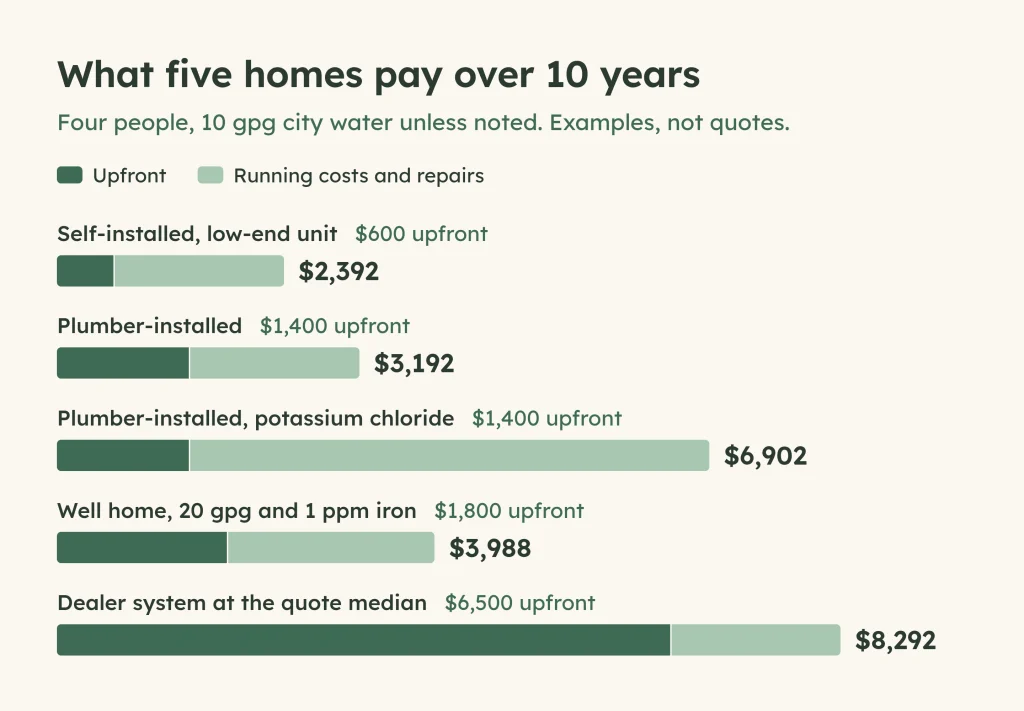
The biggest gap on this table is between quotes: $5,100 separates the plumber and dealer rows. Measured from the $3,450 independent quote median, the gap is still $3,050, so a second quote can matter more than any salt setting. Potassium chloride comes second, adding $3,710 over 10 years at a $43 bag, more than twice the softener and its installation. The dealer row keeps the same running costs so the upfront gap is easy to see. If a dealer’s unit really is more efficient, enter its rated figures and let the numbers show what that saves.
The well home shows a different cost. Its 10,950 gallons a year cost nothing on a bill, but it all goes to the septic system. That is a little over EPA’s 10,000-gallon figure because this example pairs high hardness with the cautious 4-gallon default. EPA’s guide says some jurisdictions prohibit softeners, so check local restrictions, and ask the septic system’s manufacturer or a local service provider first. Iron is counted at 5 gpg per ppm, the value in the Rheem manual. The Hellenbrand E3 manual uses 3, and either way it is a rule of thumb, not chemistry. Only dissolved iron counts: Rheem says its softener won’t remove red-water or bacterial iron.
How the salt setting changes the bill
Each extra pound of salt removes less hardness than the last. A 1 cu ft softener sold as “32,000 grain” only reaches that at a heavy salt setting. ResinTech’s data sheet for its CG8 resin (2012) shows the curve for water at 500 ppm hardness, with the grains per pound worked out by us. Your softener’s own figures take priority:
| Salt per cu ft of resin | Grains per cu ft | Grains per lb | Salt cost, example home |
|---|---|---|---|
| 5 lb | 20,000 | 4,000 | $55 |
| 7.5 lb | 25,400 | 3,387 | $65 |
| 10 lb | 29,000 | 2,900 | $76 |
| 15 lb | 33,000 | 2,200 | $100 |
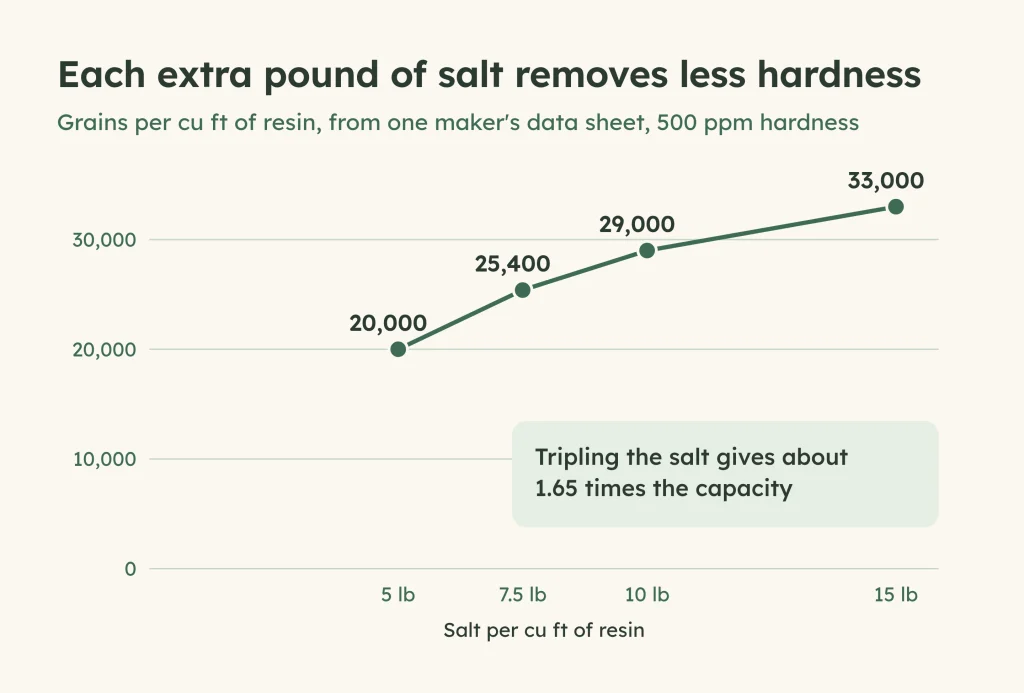
Tripling the salt gives about 1.65 times the capacity. Some of the salt savings at a low setting go back into water, because the softener regenerates more often. At about 50 gallons a cycle in a 1 cu ft softener, the example home runs about 55 cycles a year at 5 lb and 33 at 15 lb, or about 1,080 gallons and $18 more water. The net saving is about $27 a year, and it grows with hardness. The calculator does not make this link for you, because the drain water box stays fixed. When you compare salt settings, change that box too: 50 gallons a cycle is 2.5 gallons per 1,000 grains at 5 lb and 1.5 at 15 lb.
A low setting has other costs. It needs a softener large enough to go several days between cycles, and Dow’s resin manual charts more hardness slipping through at lower doses. Use the water softener size calculator to check the size at your chosen dose.
When reading a spec sheet, compare grains per pound. EPA’s guide points to softeners above 3,350 grains per pound, certified under NSF/ANSI 44. California law sets 4,000 grains per pound for softeners installed since 2002 that regenerate to a community sewer. The rating is a lab best case: the Rheem RHS42 lists 5,010 grains per pound at its lowest 2.5 lb dose, and its manual says real efficiency is “typically less”. That is why the calculator starts at 2,900.
How to spend less
- Get two quotes on the same basis. One independent plumber and one dealer, each with the model number, capacity, salt efficiency, labor and warranty in writing. Penn State’s buying tips say the same: several estimates, and everything in writing.
- Buy demand-initiated regeneration. EPA says these units are more efficient than fixed-schedule ones. If yours runs on a timer, set it no more often than needed.
- Keep outdoor water off the softener. EPA suggests branching hose and irrigation lines off first, or using the bypass valve for lawns, cars and pools.
- Don’t soften more than you need. EPA’s technical sheet for new homes even suggests softening hot water only, which is easiest to plan during a build.
- Compare with renting properly. In TapWaterData’s small sample, advertised rentals ran $14.95 to $57 a month and reported rents $40 to $100, so ask whether salt is included. Our rent or buy calculator runs your own quotes.
What the calculator leaves out
- Savings. It counts costs only. Softened water can cut scale and soap use, but the Battelle study on this is labeled a Water Quality Research Foundation study on the site of the Water Quality Association, the trade body, which supplied the test heaters and approved the protocol. We found no independent figure for a household’s yearly saving. Our guide on whether softeners are worth it weighs that up.
- Lifespan. We found no public agency figure. Sellers commonly say 10 to 15 years, and Aquasana gives both that and 10 to 20 on one page. As one data point, the RHS42 warranty runs 10 years on the tanks, 3 on the control board and 1 on everything else, or 5 if you use the maker’s cleaner, with labor included only for that first period. Ten years is our default for that reason, not a forecast.
- Price changes. Everything is in today’s dollars, with no salt or water rate rises and no loan interest. A finance plan’s total belongs in the Softener price box.
- Other equipment. It does not price iron filters, reverse osmosis or salt-free units. EPA notes softeners don’t typically treat other contaminants, so take well water questions to a certified lab or your county health department.
General information, not medical or professional advice. Cost figures are published estimates and worked examples, not quotes, and local prices vary. WaterPlain sells no equipment and takes no referral fees.
Facts checked against primary sources on 2 November 2026. Every figure is checked against the linked source.
Formulas and sources
- Upfront cost: Arithmetic on the reader's own entries, no outside figure
- Hardness counted, with iron: Rheem RHS42 owner's manual: iron setting example
- Grains removed per year: Penn State Extension: Water Softening (updated 8 Sept 2025)
- Salt per year: EPA WaterSense: Guide to Selecting and Maintaining a Water-Efficient Water Softener (May 2026)
- 40 lb bags per year: NDSU Extension WQ1031: Water Softening (May 2022), 40-pound bags
- Salt cost per year: NDSU Extension WQ1031: Water Softening (May 2022), 40-pound bags
- Drain water per year: EPA WaterSense: Guide to Selecting and Maintaining a Water-Efficient Water Softener (May 2026)
- Water and sewer cost per year: EPA WaterSense: rates are charged per 1,000 gallons
- Running cost per year: Arithmetic on the reader's own entries, no outside figure
- Running cost per month: Arithmetic on the reader's own entries, no outside figure
- Total cost over the period: Arithmetic on the reader's own entries, no outside figure
- Average cost per year of ownership: Arithmetic on the reader's own entries, no outside figure
- Grains per gallon added for each 1 ppm of dissolved iron (5, as of 2026-11-02): Rheem RHS42 owner's manual: iron setting example
Sources
- Penn State Extension: Water Softening (updated 8 September 2025)
- Penn State Extension: Tips for Buying Water Treatment Equipment (updated 1 July 2026)
- NDSU Extension WQ1031: Water Softening, Ion Exchange (revised May 2022)
- DB Supply: 40 lb potassium chloride listing (seen 2 Nov 2026)
- Homewyse: Cost to Install a Water Softener (May 2026, commercial estimator)
- TapWaterData: Water softener cost (priced 4 October 2026, commercial)
- TapWaterData: Water softener brands, prices and rentals (October 2026, commercial)
- EPA WaterSense: Water-Efficient Home Water Softeners fact sheet, 832-F-26-006 (May 2026)
- BLS Occupational Outlook Handbook: Plumbers, Pipefitters, and Steamfitters (May 2025 wages)
- EPA WaterSense: Guide to Selecting and Maintaining a Water-Efficient Water Softener (May 2026)
- EPA WaterSense: Cation Exchange Water Softeners (updated 8 May 2026)
- EPA WaterSense: Data and Information Used by WaterSense (updated 18 February 2026)
- Rheem RHS42 water softener owner's manual
- Hellenbrand E3 water softener manual (third-party copy)
- LatestCost: Water softener resin price and replacement costs (15 October 2026, commercial)
- ResinTech cation resin specifications, CG8 (rev. 2012, distributor copy)
- DOWEX Water Conditioning Manual (2011 copy)
- California Health and Safety Code section 116785 (California Legislative Information)
- EPA WaterSense Technical Reference Manual: Water Softeners (July 2023)
- Water Quality Association: Softened Water Benefits Studies
- Aquasana: How much does a water softener cost? (seller page)